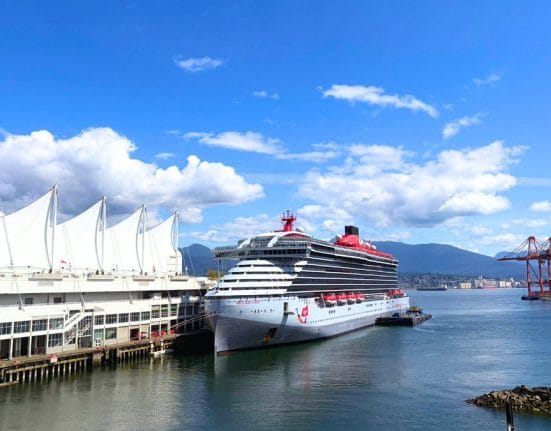
In the annals of Alaskan cruise history, there are key moments that redefine the destination experience, in a region that for decades has experienced strong, measured growth in passenger numbers and vessel calls.
By Aaron Saunders
In 1999, the first Alaska cruise departed from Seattle, Washington – bucking the conventional trend that always saw Vancouver, Canada, as the de facto homeport. Another important event was the 2004 development of Icy Strait Point, which has morphed into a story of success for the local Tlingit residents of nearby Hoonah. It is a model for repurposing formerly “dead” ports of call – a cannery, in the case of Icy Strait Point – and transforming them into authentic experiences ashore.
We may soon look back on autumn 2025 as another defining moment in the history of Alaska cruises, with the introduction of an itinerary that doesn’t really visit Alaska at all. Instead, Holland America Line’s pioneering weeklong itinerary aboard its 1,996-passenger Noordam focused on British Columbia’s Inside Passage, with port calls in Prince Rupert, Nanaimo, and Victoria – along with a day of scenic cruising in the Great Bear Rainforest, a protected area of the British Columbia coast known for its Indigenous communities, superb scenery, and breathtaking remoteness.
It’s the Alaska cruise that isn’t – and the timing of Holland America’s newest itinerary couldn’t be more appropriate.
A new way to go back to basics
CruiseTimes had the opportunity to chat with Paul Grigsby, VP revenue planning and analytics with Holland America, aboard Noordam during its first Great Bear Rainforest itinerary in early October 2025. Over dinner in the Pinnacle Grill, Grigsby told us that in designing this itinerary he was inspired by past Holland America Line itineraries to Alaska that spent more time dwelling in the sheltered inlets of the Inside Passage.
“I took a cruise last year with my family to Alaska,” Grigsby said. “It was actually the first one I’d taken since 1997, when I was on the Rotterdam V. I was disappointed to see it no longer sailed these really scenic parts of British Columbia like the Grenville Channel, which is just beautiful.”
Grigsby’s Alaska voyage coincided with a visit from Victoria mayor Marianne Alto. Alto had come along with a delegation of officials to Holland America’s Seattle offices to petition the line to spend more time in the city, rather than just the standard four-hour stopover in late evening to satisfy Jones Act requirements on voyages from Seattle.
“It started with the idea of longer day calls [in Victoria],” said Alto of the visit to Holland America’s headquarters. “When you come into a city like Victoria, and you come in at supper time and you leave by 10 p.m., you’re super-hamstrung on what you can do, and what you can offer guests.”
Most cruise lines calling on Victoria do so for just a few short hours before they depart for their homeport city of Seattle, in order to satisfy the protectionist US Passenger Vessel Services Act, which demands that foreign-flagged vessels call on a “distant foreign port” before returning to the United States.
For Victoria, British Columbia, that translates into calls that are, at best, 6 p.m. to 10 p.m. – and often even shorter. It pigeonholes guests into exploring in the dark, after hours, when many shops and attractions are closed. Rather than turning ships away, Alto wants to see ships spend longer in the city.
“We explained to her that the distances from Ketchikan to Victoria are relatively prohibitive to sail in anything less than what we currently do,” Grigsby said, citing speed and fuel concerns. “The only way to spend more time in Victoria is to design a sailing around ports that are close by.” From that request, the idea of a British Columbia-centric cruise was born.
An ideal fit for British Columbia ports
Holland America Line has a storied presence in both Alaska and British Columbia. It has sailed these waters for decades and has been a tenant at Vancouver’s Canada Place terminal for just as long. It has, in many ways, the enviable position of being recognised positively by locals – even those who have not cruised before – thanks to its sponsorship and community outreach on both sides of the border.
Feeling the time was right to experiment, Grigsby and team set about crafting a new itinerary, one that would still include an Alaskan port of call (Ketchikan), but would focus more on British Columbia. The Great Bear Rainforest, part of the scenic Canadian Inside Passage, proved to be the perfect choice, with plenty of destinations willing to welcome Holland America Line with open arms.
“This is an interesting test, because this is a unique product,” said Marianne Alto as Noordam sailed towards Nanaimo, British Columbia. “It has the ability to make [the passenger and local experience] even better.
“In the same way, I think if the industry itself starts to look for this type of adaptation, both in the presentation and creation of unique products, but being able to be balanced against the [industry’s] message around different types of environmental change and the sustainability features,” she said.
A delegation of local officials and media met Noordam when it docked in Nanaimo; enthusiasm was not marred by the wet and windy weather. Noordam would be the city’s fourth, final, and largest vessel of the 2025 cruise season.
Nanaimo mayor Leonard Krog jokingly promised better weather for Noordam’s next visit – one of three on the books for 2026, with Azamara Pursuit making up the other four of Nanaimo’s seven total calls for the upcoming season.
Alto spoke too of the need to build trust and relationships with cruise at every level of local governments. “In Victoria, there’s a bunch of people coming on [Noordam] from our local leadership, including the new police chief, actually,” she said. “And they’re going to do a complete sustainability tour of the ship. That’s a critical part of the message, because it won’t survive if [cruise] continues to be able to be portrayed as this behemoth of consumption.”
Alto said that Holland America Line’s long-standing presence in the region, in addition to the smaller sizes of their ships, helped reassure other British Columbia ports that may be leery of accepting megaships from other cruise lines.
“There’s so much potential for these different coastal cruises, and it would bring such incredible benefits to some of the smaller communities in British Columbia, as long as it’s managed volume-wise,” said Alto.
Holland America innovates as Alaska gets crowded
For Holland America Line, the issue of when to offer a new itinerary, particularly during the increasingly lucrative and all-too-short Alaska cruise season, was a big decision. Ultimately, the line decided to test out its first two voyages aboard Noordam in the shoulder season: October 2025 and April 2026.
“It’s a bit of a risk,” Grigsby told CruiseTimes. The safe bet would be to have Noordam do one more late-season Alaska cruise, or head over to Asia-Pacific a week early, he said. “I was able to convince our management to take a chance on this itinerary.”
This first sailing on Noordam sold so well that Holland America duplicated the itinerary twice in 2026 and worked it into two additional 18- and 28-day itineraries aboard Noordam and smaller fleetmate Zaandam. Holland America will repeat that pattern in 2027, thanks to increased demand for these unique voyages.
“It rated very high in guest satisfaction and promoter score KPIs,” said Grigsby, post-voyage, of the Great Bear Rainforest itinerary. “It turns out it also produced a lot of on-board sales for other Holland America cruises as well.”
The timing of introducing these new itineraries through the Great Bear Rainforest is prescient: the 2026 Alaska season is poised to be the largest on record, with more lines sending more ships carrying more passengers and crew than ever before. In 2026 alone, MSC Cruises, The Ritz-Carlton Yacht Collection, and Virgin Voyages will make their debuts in Alaska, and other lines, like Crystal, will return after a protracted absence.
Even as early as last year, residents in Juneau sought to limit the capacity of the town, with a daily limit of 12,000 passengers on Saturdays and of 16,000 on all other days set to take effect in 2026. Juneau has also raised docking fees for the 2026 season, and recently sparred with Royal Caribbean over that line’s plans to build a new cruise terminal on Juneau’s Douglas Island – something, it seems, the line neglected to tell elected officials and residents when it dropped the news on the town in late 2024.
If the 2026 cruise season signals a return to a more acrimonious relationship between Alaskan towns and cruise lines – something that was only recently reset by the Covid-19 pandemic and associated shutdowns for 2020 and much of 2021 – then Holland America’s new itinerary developments in British Columbia and northern Alaskan ports like Valdez and Kodiak signal a more cautious approach for the line that has been sailing these waters for over five decades.
As a long-time tenant of Alaskan ports, it’s no secret that Holland America and sister line Princess are treated to preferential berthing locations and first dibs on permits for Glacier Bay National Park. It’s a legacy that, from the thoughtful planning of its first Great Bear Rainforest itinerary, it is eager to keep and burnish as it expands into British Columbia.
Great Bear Rainforest: Alaska’s hidden counterpart?
With marquee Alaskan ports bulging to capacity in 2026, the push to diversify the Alaskan cruise experience is in full swing. The Inside Passage, most of which exists in Canadian waters, is often sailed through but rarely visited by big ships, which are generally more content to steam northward through the most pristine sections of the passage at night time in order to make that morning-after arrival in Ketchikan or Juneau.
Holland America Line is in a unique position, too: its Vista-class vessels, and even slightly larger Signature-class ships, are the perfect size to navigate these waters safely. Many of the larger ships from Norwegian, Royal Caribbean, and even Princess would be too big to safely transit narrow passageways like Grenville Channel and its associated waterways.
Thanks to its more midsize fleet, Holland America Line is able to go where others cannot. It can recreate the more intimate Alaskan itineraries of the past, focus on new ports of call on both sides of the Canada–US border, and offer up unparalleled scenic cruising. And, in areas where docking facilities are lacking or insufficient, executives are already musing about bringing the destination to the passengers by having local performers and groups on board.
Holland America did just this on its Great Bear Rainforest itinerary, offering up a local Indigenous performance in Prince Rupert that had the three-storey World Stage theatre packed to standing room only.
In an Alaska that looks increasingly crowded, Holland America just might have found the secret weapon to offer more itineraries and reduce congestion at the same time, in British Columbia’s Great Bear Rainforest.