

Cruise Saudi, Saudi Arabia’s Public Investment Fund (PIF)–owned organisation that was officially launched in 2021 to promote the country as a cruise destination, has taken its next step by establishing its own cruise line that will focus on the Saudi and a wider Arabian source market.
by Kari Reinikainen
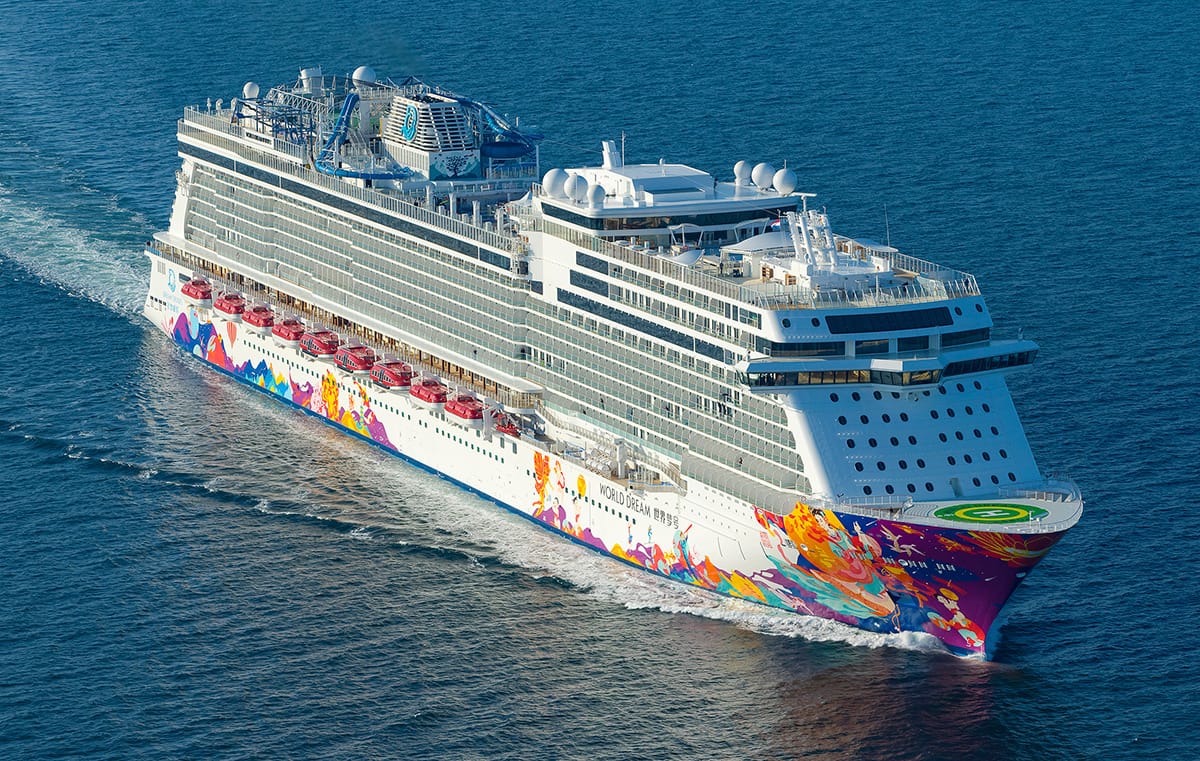
Aroya Cruises, as the new company is named, bought the 2015-built 150,695-gross-ton World Dream from the creditors of the failed Genting Hong Kong group in winter 2022. At the time of writing, the ship is at a shipyard in Germany to undergo a transformation for its new role.
“The cruise ship is currently undergoing refurbishment to become Aroya Cruises’ first ship,” Lars Clasen, CEO of Cruise Saudi, told CruiseTimes. “The new name as well as details about the level of work, timeline, and investment will be announced during the commercial launch, but the dedicated Aroya Cruises team are working hard to ensure the facilities onboard are of the highest standard for guests.”
The company will cater for Saudi nationals, expats, and regional visitors as well as other Arabian countries. All aspects of the product will be tailored to meet the requirements of this market. “Everything from the staff and the food to the way rooms are furnished is designed to reflect Arabian preferences,” said Clasen. The company has hired Saudi nationals who understand the needs and wishes of prospective passengers, and they have been working hard to ensure the experience on board is relevant and bespoke.
Dining is one element that will differ from other cruise lines, at least to a degree. “All ships will have halal-friendly dining options,” Clasen said, implying that the company would eventually have more than one vessel. Details about the dining concept on the first vessel would be disclosed in the near future, as would its itineraries – to include both domestic and international destinations and both the Red Sea and the Arabian Gulf.
“Aroya Cruises is a pioneer in the cruising sector,” Clasen said. “Being tailored to the Arabian market sets it firmly apart from other cruise brands. From a wider Cruise Saudi perspective, having strong partnerships with global cruise lines is instrumental to the overall company vision, and Aroya Cruises having a distinct offering will allow it to operate cohesively alongside our valued partners.”
First cruise operator focused on Arab market
The Saudi economy remains heavily dependent on oil and gas exports, and the government has embarked on a programme to reduce this dependency and widen the basis of the country’s economy. The establishment of Cruise Saudi is part of these efforts, and the organisation aims to provide 50,000 direct and indirect jobs in the country by 2035. Against this background, the establishment of Aroya Cruises was a milestone, Clasen said.
Saudi Arabia has set a target to reach 1.3 million international and local cruise passengers by 2035. For Aroya Cruises, this means that future growth of the fleet is likely. “On a wider scale, we hope the Aroya Cruises fleet will continue to grow, in line with Cruise Saudi’s wider efforts to put Saudi on the global cruising map,” Clasen said.
He declined to comment on whether the company would be interested in contracting newbuildings in the future. Growing a cruise fleet beyond one vessel to at least two or three is often deemed a priority, because the costs of the land-based organisation do not increase in tandem with the introduction of additional vessels. Another advantage to growing a fleet is a line’s ability to offer a wider variety of itineraries than what is possible with just one ship.
The vessel that Aroya Cruises now has is essentially a contemporary market ship. Among the interesting aspects of the company’s future will be what kind of tonnage it acquires. A cruise brand usually focuses on a single segment of the industry – contemporary market, premium, or luxury; Aroya Cruises’ first step suggests that it might focus on large, contemporary market vessels in the future as well.
The growth of source markets elsewhere has usually followed a two-pronged approach. International brands can drive this expansion by introducing tonnage in a new market, sometimes with adjustments made to cater for local requirements. Royal Caribbean International, MSC Cruises, and Costa Crociere are examples of contemporary market brands that operate on several source markets and that have played a significant role in growing many of them.
However, brands that cater exclusively for a particular source market are often important in the growth of the cruise industry, as they lower both cultural and linguistic barriers that might otherwise discourage some potential passengers from booking a cruise. Companies like P&O Cruises in the UK and Aida Cruises in Germany had a major role in the rapid growth of their respective source markets from the 1990s onwards.
Unless a brand that focuses on a single source market is part of a major cruise shipping group that can supply it with the vessels it needs from other units of the group, the new line will need significant investment to build up its business.
The introduction of Aroya Cruises fits this format, as several international lines are already establishing themselves in Saudi Arabia, where they also bring international passengers. Given the deep pockets of the Saudi PIF, growing the business of Aroya Cruises is unlikely to face financial hurdles.
