Much attention has fallen on the cruise industry’s rapid recovery from the pandemic and the sector’s subsequent expansion and quick resumption of newbuilding orders. There has been less focus on the probable boom in vessel refits, which will present considerable challenges.
By Kari Reinikainen
Cruise ship owners depreciate the book values of their vessels over a period of 30 years. At roughly the mid-point, 15 years of age, ships usually receive major upgrades, both technical and cosmetic. Older vessels need to be updated to ensure that the facilities and services they offer to their passengers do not become commercially obsolete.
Ageing ships
The cruise industry’s rapid growth has also meant that ships have become larger. After the first 100,000-gross-ton-plus ship entered service in 1996, the 150,000-gt barrier was breached a decade later. In 2009, the arrival of Oasis of the Seas took the figure above the 200,000-gt mark.
In the years since, the number of cruise ships weighing over 150,000 gross tons has increased quite rapidly. As these vessels reach the mid-life refit age, refit yards, contractors, and suppliers involved with these projects are expecting a busy time ahead.
Cruise ship newbuildings over 150,000 gross tons
| Years built | Numbers of vessels |
| 2005–2009 | 4 |
| 2010–2014 | 2 |
| 2015–2019 | 18 |
| 2020–2024 | 15 |
| 2025 | 7 |
Source: Shippax Guide 2024


Aside from the expected logistical, time-limit, and other technical challenges, one of the central questions will be: Is the industry ready for this disruption and hefty investment?
Markus Aarnio, chief naval architect at the Finnish consulting company Foreship, said that the cruise ship refit market would pick up momentum in the years to come. As this will include larger vessels in greater numbers than before, shipyard capacity constraints may emerge in some cases. “However, there are several companies involved in this business, and many of them have their own fabrication facilities, et cetera,” Aarnio told CruiseTimes.
The total gross tonnage of cruise ships of more than 150,000 gross tons dropped significantly in 2010–2014, as the number of deliveries halved from the previous five years. This was due to the financial crisis of 2008 that made owners cautious of ordering newbuildings.
There has been a strong recovery since then, however, especially in 2015–2019. Although the total gross tonnage of large-size newbuildings declined slightly in 2020–2024, the deliveries scheduled for 2025 alone amount to about half of the previous five-year total.
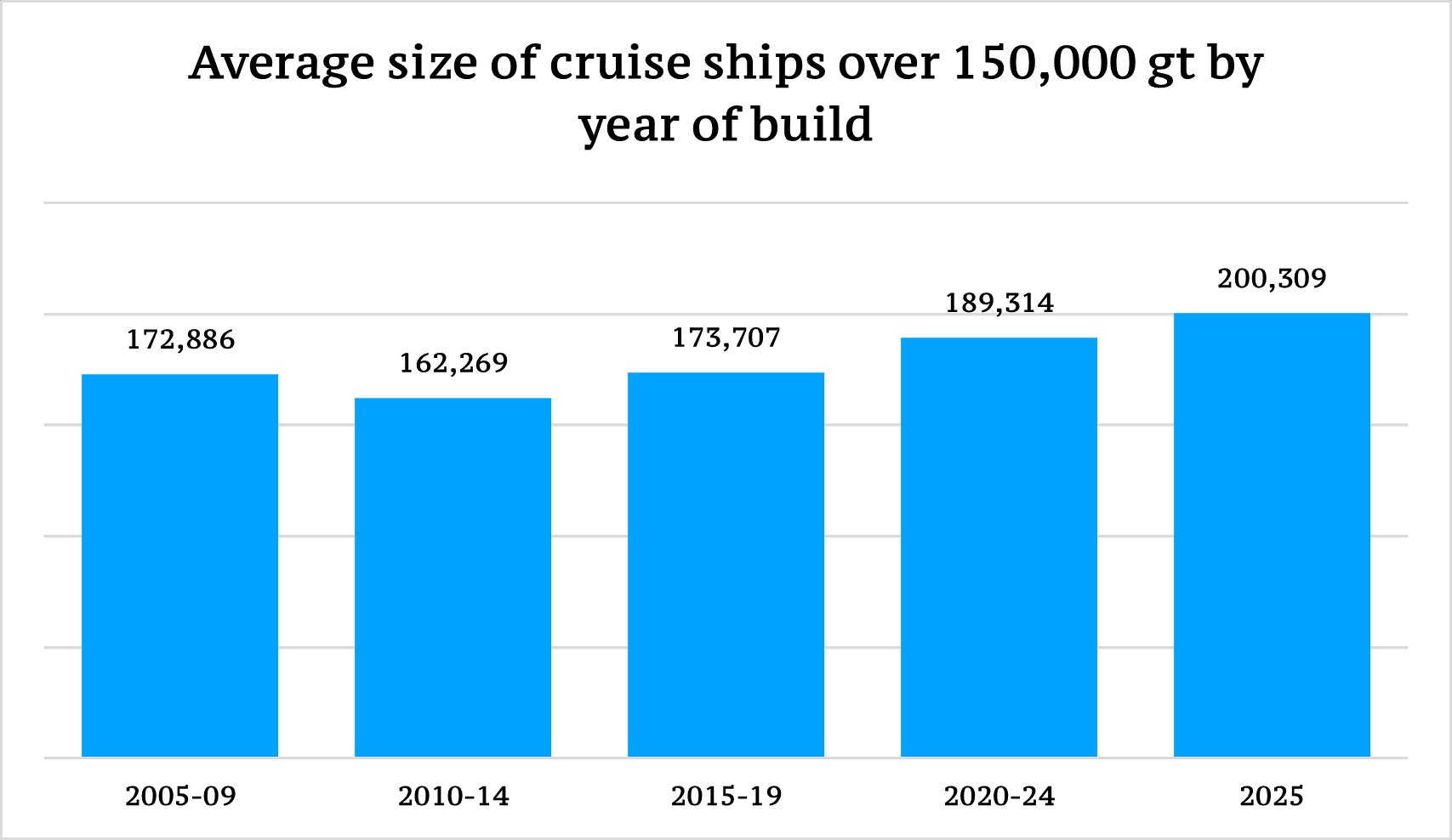
Interestingly, the average size of cruise ships in this largest category has continued to rise since 2015, following a slight drop in 2010–2014 from the previous five years.
Source: Shippax Guide 2024

The growing average size of the largest vessels is meaningful in this connection, because it implies that the forthcoming individual refit and upgrade projects will gradually become larger in scope and costlier in investment.
Robert Galinski, global business director of cruise at DNV, said that the cruise ship fleet, generally speaking, was ageing and that there was a very significant push for newbuildings, filling yard orderbooks as far as 2035.
“The size of the vessels and the discussions on alternative fuels, or alternative-fuel-ready designs, are putting renewal of the fleet at the forefront, as opposed to a focus on retrofits,” he said. “Having said that, the life of a cruise vessel far outweighs the life of a cargo vessel [commercially], and therefore we know that currently operating cruise vessels will be likely to need significant upgrades if they are to comply with the IMO emission reduction rules, especially in regions like Europe.”
Meeting challenges
Seeing the coming boom of large cruise vessel refits and retrofits, various ship repair yards and their armies of suppliers are preparing themselves. If not, they ought to be. Some have already carried out refit projects. What is new with the forthcoming boom, other than the size and number of the vessels, will be the increasing complexity of the projects – which may include retrofit of engines, fuel tanks, and propulsion systems – and the possible longer times required to complete them. But shipyards and suppliers have years of experience and continuous innovative technologies to fall back on.
Mantas Dubavicius, VP business development at Aros Marine, the Lithuanian turnkey outfitting and project management company, said that, as the cruise industry continued to expand its fleet with larger vessels and as these ships reached their mid-life refit cycles, demand for high-quality refits would inevitably rise.
“In 2024 alone, Aros Marine successfully completed 73 projects across 12 countries, demonstrating a clear industry-wide focus on modernisation and sustainability,” he said, adding that 50 of these involved interior refits and 23 included HVAC systems.
Whether or not it is possible to carry out such refits in two to three weeks, which is the normal time allowed for most projects, depends on the scope of work. “A two-week turnaround is feasible for well-planned refreshment projects involving soft refurbishments, such as cabin upgrades, public-space enhancements, or selected technical improvements,” Dubavicius said. However, larger structural modifications, sustainability retrofits, and HVAC overhauls may require additional time to ensure seamless execution.
In response to the question of whether the suppliers and contractors had enough workers and other capacity to meet a possible increase in demand, Dubavicius said that the industry faced ongoing workforce challenges, but that leading suppliers and contractors, including Aros Marine, were proactively recruiting personnel and scaling up capacities. “In 2024, we achieved over €100 million in revenue, reflecting our ability to grow, invest in skilled talent, and expand operational capacity,” he said, adding that the company currently employed on average 480 people per project.
Companies like Aros Marine are continually strengthening their subcontractor networks and implementing digitalisation solutions to enhance project efficiency. “Collaboration among shipyards, suppliers, and contractors remains crucial to ensuring the availability of materials, workforce, and technical expertise,” said Dubavicius.
Apart from a handful of passenger ship refit specialists, conventional ship repair yards are at the centre of this business. Their expertise in general maintenance and refurbishment will be much in demand.
The relentless growth in commercial demand for vessel capacity also means that more refit work needs to be carried out without taking ships out of service, according to Mark Henderson, managing director at Magicman, the UK-based specialist in repairing damaged surfaces. “In-service refurbishment is growing rapidly, both with older ships and the number of newbuilds and specialty ships and river boats coming to the market,” he said, adding that even newbuildings can have issues that need resolving before entering service.
Minimising disruptions to normal commercial operations of the ships is part of the project planning. “Magicman has seen significant growth with in-situ hard-surface repairs as awareness of our scope filters around the industry – coupled with our constant research and development of new repair techniques and products to meet the demand of new substrates,” Henderson said.
The capital expenditure burdens of mid-life refits for shipowners, especially to large vessels, are widely acknowledged. Cost is always an issue, and savings by choosing in-situ repairs can be considerable.
Lessening pressure
Based on the vessel age data outlined above, we expect the number of mid-life refits to start rising substantially in about five years’ time, when a larger number of megaships built from 2015 onward begin to reach 15 years of age.
Indeed, looking at the interiors of some of these vessels in service today, they are already in need of upgrading, especially when compared to the standards of the latest newbuilds. The 2030 regulatory milestone may further propel the need to refit many of these floating behemoths. The investments required for the upgrades will be substantial, as they will also encompass costly technical updates and often refits of alternative-fuel technology.
Moreover, traditionally, refits are usually carried out concurrently during the mandatory vessel dry-docking. With such a degree of complexity, will 14 to 21 days be long enough for undertaking extensive transformations? Of course, this pressure can be lessened by better planning, such as sending a team on board before the ship reaches the dry-dock. But such measures will only have limited effects. A larger workforce and quicker finish times will be essential to meet the challenge of minimal disruption to the ships’ commercial activities.
The cruise ship refit and refurbishment business will expand further in the coming years as the number rises and pressure mounts.