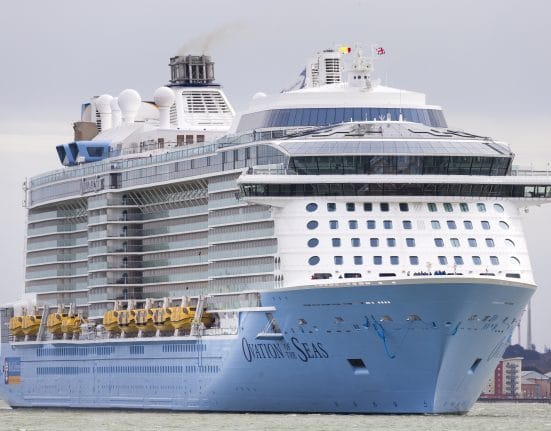
Cruise ships require frequent dry-docking, which in itself is expensive, and the loss of revenue from taking ships out of service adds a lot to the bill. The industry is looking for ways to mitigate the costs and ensure access to facilities as and when required, including acquiring stakes in dry-docks.
By Kari Reinikainen
Flag-state rules and regulations stipulate that a passenger ship should be inspected, out of water, every 12 months. Class rules say that this should be done twice in every five years. “You can make an arrangement with your flag state and classification society to have an in-water survey instead of an annual or intermediate dry-docking,” said John Garner, managing director of UK-based JG Maritime Solutions Ltd.
This requires that the vessel has an In-Water Survey (IWS) class notation, where approved divers take video footage of the inspection of the underwater hull. Where the vessel has an IWS notation, the conditions of the underwater hull and high-resistant paint need to be confirmed at each dry-docking in order for the IWS notation to be maintained.
Some lines, instead of a dry-dock, carry out an in-water survey every 12 to 36 months and extend the intervals for that to six or even seven years from the ordinary five, Garner said. The ship will obviously have to comply with all relevant regulations at all times, and if a defect such as damage or deterioration is detected during the in-water survey that requires early attention, it will have to be put right immediately, as the defect would make the ship non-compliant. When this is not the case, such as a light indentation of the hull and frames, the matter can be noted and put right at the next dry-docking.
If it is not possible to carry out a survey while the ship is in the water, for example because the water is not clear enough to allow proper video footage to be shot, the owner, class society, and flag state can agree to carry out a 24-hour dry-dock to check the hull, rudders, propellers, thrusters, et cetera, to meet the survey requirements.
The machinery side of the vessel is inspected either during the intermediate and five-year dry-docking or under a programme of Continuous Survey of Machinery (CSM). This is becoming increasingly complicated, as new systems, such as fuel cells, battery packs, and other new energy system, are making their way on board ships.
“There is a significant amount of planning to do, as it is a complex programme,” Garner said. Already today, there is a limited number of dry-docks that can accept, and have availability for, the largest cruise vessels in service, which adds a further dimension to the planning requirements of dry-docking these ships.
Planning matters
In Norwegian Cruise Line Holdings’ third-quarter 2023 conference call, CEO Harry Sommer said: “To give you just one example, last month we took the time to tour Norwegian Jewel ahead of the scheduled 2025 dry-dock. We walked through each planned project while on board, stopping to get real-time guest feedback to help identify the highest-value opportunities. The result of this more methodical approach resulted not just in lower cost but it also shortened the expected length of the dry-docking itself by nine days, which will allow us to return the ship to revenue-generating service that much faster.”
A spokesman for MSC Cruises told CruiseTimes that the company had six vessels going to dry-dock in Malta during 2024: MSC Armonia, MSC Opera, MSC Musica, MSC Magnifica, MSC Splendida, and MSC Grandiosa.
“Planned works include periodical hull maintenance and painting, machinery and electrical maintenance, refurbishment of cabins and public areas, plus tests and inspections for class renewal. MSC Musica, MSC Magnifica, and MSC Splendida will also be retrofitted for shore power,” he said. “MSC in 2020 invested in the Palumbo dry-dock in Malta, and this provides us with full flexibility in planning our refurbishment schedule. Our ships’ itineraries are planned around the dry-dock schedule so that they are in operation in the Mediterranean Sea for when they are due to be refurbished.”
The Palumbo yard also allows MSC to maintain a high repair and maintenance standard due to the experienced workmanship and yard infrastructures. “We also have the advantage of having a dedicated warehouse in the yard where we store well-in-advance spare parts, equipment, and materials required for dry-docks, and this constitutes a significant advantage in managing the aspects of logistics,” the spokesman continued. “In the same warehouse, we store critical spare parts and components for propeller shafts and Azipod propellers for each class of ship, so that they are always available if required.”
The dry-dock cycle is fundamentally determined by classification society rules and regulations and by the age of the ship, with a shorter interval for older vessels. “We have a 10-year outlook, and dry-dock frequency is set according to classification society rules and regulations, typically every two to three years or every five years depending on the ship’s age. Our internal policy ensures an average of two stops per ship every five years, although this may be adjusted according to the deployment and itineraries of individual vessels,” the spokesman said.
MSC books the dry-dock availability in five-year time frames, because the vast majority of work that needs to be conducted cannot be done when the vessel is in operation, and the dry-dock is essential to maintain standards.
“Of course, regular routine maintenance or refurbishment activities are carried out as and when required during any of our vessels’ given itineraries. Our fundamental approach is to plan far in advance what work needs to be undertaken once the ship enters dry-dock and when it will be completed and return to commercial service. This requires detailed planning, hard work, dedication, and a paramount attention to detail,” he concluded.
For a cruise line, the total time a ship spends in dry-dock is a crucial factor, because the resulting loss of revenue is often a large part of the total cost of the operation, according to Chris Millman, VP of marine technology at Carnival Corporation & plc.
The revitalisation of Grand Bahama Shipyard Ltd in Freeport is therefore very important for Carnival, because the facility lies just some 90 miles from major turnaround ports in South Florida. The shipyard – jointly owned by Carnival Corporation, Royal Caribbean Group, and the Grand Bahama Port Authority – has two large floating dry-docks on order that are scheduled to be commissioned in late 2025 and late 2026.
The larger one will be 413 metres long and 68 metres wide, while the smaller one will be 357 by 59 metres. “The larger one will have a lifting capacity of 130,000 tonnes, which is enough to lift the Icon-class ships,” Millman said.
The Grand Bahama facility originally had three floating docks, but two of them were damaged during hurricanes. “It has been in business for 25 years, and has an experienced workforce of its own which is supported by expat workers on long-term contracts,” he said.
Carnival prefers to dry-dock its ships in or close to the regions where each vessel operates, in order to reduce the time spent on sailing to and from the facility. On some occasions, these positioning voyages can be sold for fare-paying passengers, which changes the cost dynamics significantly.
As the largest cruise group, Carnival dry-docks 30–35 vessels a year. In each case, it does as much work as is required and possible, to minimise the frequency of taking ships out of service.
It is beneficial to use the same shipyards in various parts of the world to dry-dock ships, because then both parties come to know their work practices, and building on this learning curve benefits both shipowner and shipyard. However, Millman said that the door also remained open for yards which the company had not used, or not used regularly, to discuss dry-docking services.
Dry-dockings often involve a large number of suppliers and contractors, and from their point of view the most important time-saving measure is simply engaging early with the supplier. “Digitalisation is a vital tool for managing refit projects. It helps save time during the survey, and it ensures the right parts are sourced on time. But the earlier this starts in the project lifecycle, the more confident a vessel owner can be that there will be no need for a last-minute rush to fix any unforeseen problems,” said Gard Sem, director of Cruise Division at W&O Supply, a global marine valve and maritime fitting company. “Suppliers and contractors can always start working together earlier. In our view, the earlier we engage with contractors, engineers, and vessel owners, the sooner we can offer our expertise in sourcing to make sure that, where a part is specified, the one supplied is the best product for the job, at the right price.”
Logistical challenge
Since loss of revenue is such a big part of the total cost of any dry-docking, Carnival prefers to dock its ships during the winter season, to minimise the impact on business demand during the peak summer season, Millman said.
Most of the dry-docks that handle cruise ships are in Europe, where large facilities were built mainly in the third quarter of the 20th century with the construction of large tankers in mind, a business that has since been lost to Asian yards. In the US, there are some large facilities, but their use for work on cruise ships is complicated by the fact that the US Navy has a priority to use them.
The only major facility in the western hemisphere that focuses on cruise ships is the Grand Bahama dry-dock, but until it receives its new, large, floating docks, its facilities are not large enough to serve the biggest cruise vessels, according to Rogier van der Laan, sales manager cruise at Damen Shiprepair & Conversion.
A dry-dock that handles a cruise ship should be wide enough to allow the stabilisers to be extended out in full. But draft is perhaps the most crucial factor going forward: the draft of a cruise liner does not change much between loaded and empty conditions, and only a few dry-docks can take in ships drawing more than 10 metres. Damen has two very large facilities, and the one in Rotterdam can accept vessels drawing up to 13 metres of water.
Dry-docking of a cruise ship is first and foremost a logistics operation, which has to handle two courses of flows: new materials and equipment that will be installed on board, and old ones that are taken out and are increasingly headed for recycling.
Bas Loohuis, commercial director at Damen Shiprepair & Conversion, said that the dry-docking and upgrades of a large cruise ship required up to 1,000 containers with materials and equipment at the job site before the work could start. Tents are erected next to the dock to facilitate the handling of the materials. “It is a clockwork project,” he said.
Cruise lines usually allocate 14 to 21 days for dry-docking each of their ships. For a ship operating seven-night cruises, it means removing two or three of these. “A delay in the schedule of the docking period is unacceptable, as the next cruise is already planned,” Loohuis said.
Other factors can affect the time it takes to carry out all the planned work. Coatings, for example, need to dry before the next layer can be applied, and again this can be done only when other work on the hull has reached a stage that will allow it.
‘‘When it comes to potential problems, prevention is better than cure. Typically, problems arise either because a part was overlooked during a ship check, and now the contractor finds it needs to be replaced, or because the contractor has a replacement part, but it isn’t right for the job. These snags are typically communicated in late-night phone calls, where we are asked to find the right part, yesterday. A careful inventory of parts, accurately identifying what needs replacing, can avoid these problems,’’ said Sem of W&O Supply.
Increasing complexity
Damen and the German cruise ship builder Meyer Group’s Meyer RE unit, which focuses on refitting cruise ships, entered a cooperation agreement in early 2023. The partnership is bearing fruit and offers insights for both parties regarding how to make things run more smoothly in the future.
A key element here is that involving a cruise ship builder in dry-docking and refit operations allows access to lots of drawings and expertise that the builder has about the ship in the work, said Henning Jongebloed, head of sales at Meyer RE.
This leads to cost and time savings, as it reduces the chances of unpleasant surprises arising from insufficient knowledge of what a work team would actually face when the project reaches the execution phase. Also, contractors and suppliers who worked on the ship can be involved, and various materials and pieces of equipment can be sourced through them – another way of saving time and money, compared to finding new suppliers for all the necessary items.
Ships are becoming increasingly complex due to new energy sources and related technologies that are making their way on board. “A lot has happened in just a year or two. The pace of technology development is accelerating,” Jongebloed said.
This means that in a series of cruise ship newbuildings, updated technologies will be installed as the series progresses from the first ship onwards. This was the case, for example, with the Excellence class, which Meyer built for various brands in the Carnival group.
The need to upgrade technologies in the future in connection with dry-docking is becoming increasingly important, Jongebloed said.
Digitalisation is important even from the point of view of suppliers and contractors, as it is a crucial part of maintaining an accurate understanding of what has been installed on a vessel, said Sem of W&O Supply. “Often, if we are conducting a ship check on a vessel for the first time, we are doing so against a paper-based list of materials that, after years of repair and maintenance, bears no resemblance to what is actually installed,” he said. By contrast, digital solutions allow sourcing of data on valves installed years ago. “Quickly reading them on a handheld device makes conducting surveys and identifying parts to replace much easier,” he concluded.