As the conflict between Iran and the United States and Israel enters its fifth week, an increasing crisis is presenting itself to the shipping world. There are currently an estimated 3,000 ships of all shapes and sizes trapped in the Arabian Gulf, including five cruise ships. An estimated 20,000 seafarers are stuck aboard ships, some of which are beginning to run low on basics like food, fuel, and other supplies.
For the cruise industry, the situation is increasingly problematic. Though passengers are off the affected ships, cruise lines now face a logistical nightmare: how to get their ships out of the Middle East, safely, and all the way over to Europe, where most are scheduled to begin their summer season cruises in just a few short weeks’ time.
While it’s clear that more voyages will be cancelled as ships struggle to leave the region, what isn’t clear is how long this will last – and how cruise lines can possibly free their ships.
“What makes the present situation unusual is not the need to redeploy ships but the scale and immediacy of the disruption,” Giora Israel, former SVP of global port and destination development for Carnival Corporation and now president of Giora Israel LLC, told CruiseTimes. “Six ships from four cruise companies were unable to complete their voyages and remained in the region. This is a rare operational scenario, even by the industry’s long historical standards.”
Which Cruise Ships Are Stuck in the Middle East?
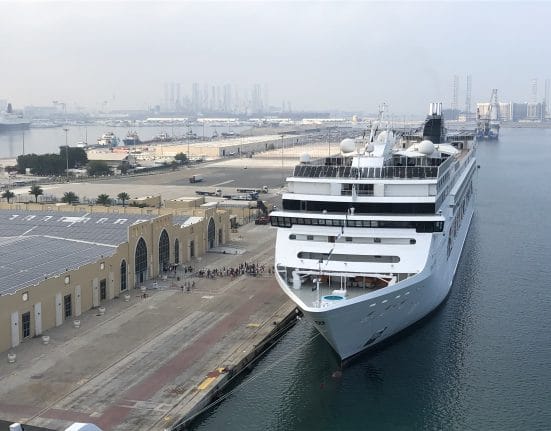
Currently, the following ships are stuck in the Middle East:
- Celestyal Discovery (docked in Dubai; Celestyal Cruises)
- Celestyal Journey (docked in Doha; Celestyal Cruises)
- MSC Euribia (docked in Dubai; MSC Cruises)
- Mein Schiff 4 (docked in Abu Dhabi; TUI)
- Mein Schiff 5 (docked in Doha; TUI)
- Aroya (docked in Dubai; Aroya Cruises)
Celestyal Cruises’ entire fleet is currently stuck in the Middle East, which could present an enormous financial issue for the company should the conflict in the region drag on.
TUI has publicly announced that it has also repatriated crews aboard Mein Schiff 4 and Mein Schiff 5, bringing both vessels down to minimum crewing levels that the industry hasn’t seen since the Covid-19 pandemic began six years ago.
“The remaining crew – deck and engine teams, supported by a minimal number of hotel staff – must stay aboard,” said Israel. “A ship must remain ‘in class’, meaning it must be able to fight fires, maintain critical systems, manoeuvre if required, and comply with flag state and classification society standards. For a large ship carrying up to 3,500 passengers, the minimum safe manning level is typically around 100 crew members, depending on the vessel and regulatory requirements.”
Until the conflict resolves, few options are open to cruise lines.
No Good Options
With the Strait of Hormuz effectively closed, there is no way for the vessels to get into the Gulf of Oman and out to the Arabian Sea, to transit either the eastern coast of Africa or the Suez Canal.
Ships cannot sail west; the Arabian Gulf has no other openings to the sea, and the Gulf terminates on the borders of Iran, Iraq, and Kuwait.
Some cargo and bulk carriers have had luck hugging the coast of Iran and avoiding the shipping lanes, but these have all originated from Iranian ports of call. It is highly unlikely that the affected cruise ships would be able to do a similar route.
There are really only two options for vessels to leave: if the war concludes and the strait reopens; or if the IMO, EU, or other government officials are able to negotiate a safe passage route for maritime shipping.
With the humanitarian crisis growing, it seems some relief will need to be offered to seafarers trapped on ships that are going nowhere fast.
Insurance Could Play a Role in Repositioning Vessels
A large stumbling block for cruise lines in repatriating these vessels could be insurance.
Maritime insurance companies have largely removed war-risk coverage for ships in the Middle East. So far, this has mostly affected tankers and bulkers trapped in the region – insurers will no longer cover the vessel or the cargo, making it impossible for these critical ships to set sail.
Some of these same maritime insurers also cover the cruise industry. If their insurance is revoked, it would be nearly impossible to legally set sail from the region, even if the opportunity presented itself.
Trying to re-insure vessels for the region is becoming cost-prohibitive as well. A $100 million tanker that used to cost $200,000 to fully insure against loss is now running over $1 million for a single voyage, according to Al Jazeera.
Sailing without insurance likely isn’t an option at all: it would put the cruise line at tremendous financial risk, and likely result in heavy fines, jail time, or both.
It is unknown at this time whether cruise lines have been affected by the same insurance issues that have beset the cargo industry.
Start of European Cruise Season Threatened for Affected Vessels
The start of the European cruise season for the affected vessels stands to be highly impacted, with sailings into April already axed by Celestyal, MSC, and TUI.
Even if the Strait of Hormuz were to open tomorrow, the voyage to Europe via the Suez Canal takes about a week and a half, in the best-case scenario. And with over 3,000 vessels trapped in the region, it will put increased strain on the Suez passage once the ships are able to move again.
Ships will also likely need to bunker fuel somewhere along the way and re-provision, adding to the already complex logistical considerations for cruise lines.
For now, all they can do is wait for something to give – and keep their ships in the relative safety of their current ports until the crisis at hand passes.
But as Giora Israel points out, the cruise industry is remarkably resilient and adaptable to change.
“Over the decades, four major forces have consistently shaped the industry’s strategic and tactical deployment decisions: the economy, geopolitics, regulatory frameworks, and technological change,” Israel said. “Among these, economic cycles and geopolitical events remain the most persistent and disruptive.
“Historically, wars and regional instability have forced cruise lines to make significant itinerary changes with little notice – sometimes within days, hours, or even minutes,” he said.
CruiseTimes will update this story with more information as it becomes available.
– Aaron Saunders, Digital Editor