

Cruise tourism is not universally welcomed in Europe. Dialogue and cooperation are key to changing this.
By Mike Louagie
In 2022, residents of Ghent in Belgium were invited to participate in a debate about tourism. One of the main conclusions from the discussion was that there was little support for cruise tourism in the city.
As a result, Ghent decided to discontinue allowing ocean cruise ship visits and to limit river cruise to four vessels per day. The aim was to prioritise “pyjama tourism” over “selfie tourism”, as one newspaper put it.
Cruise tourism was seen to contribute little to Ghent’s economy. So, not focusing on cruise business became one of the city’s tourism strategies. But other ports and cities have different perceptions and apply alternative strategies.
Perception versus reality
Zeebrugge is the port of Bruges, Belgium, one of Europe’s most visited cities. Welcoming 475,000 cruise passengers and 169 ship calls per year, mainly by the largest ships, Zeebrugge radiates dynamism of cruise business.
“In the past, it was not always easy to convince the people and the politicians of Bruges that cruise was a positive thing for the community,” said Piet Vandenkerkhove, cruise manager of Port of Zeebrugge. “Dirk De fauw, the current mayor of Bruges, embraces the positive aspects of cruise tourism. Cruise season is now much more spread out than it used to be. Today, the period from October to March is the busiest, and most ships call midweek. That fits perfectly well with the local economic activities by often filling the gaps in the trading times.”
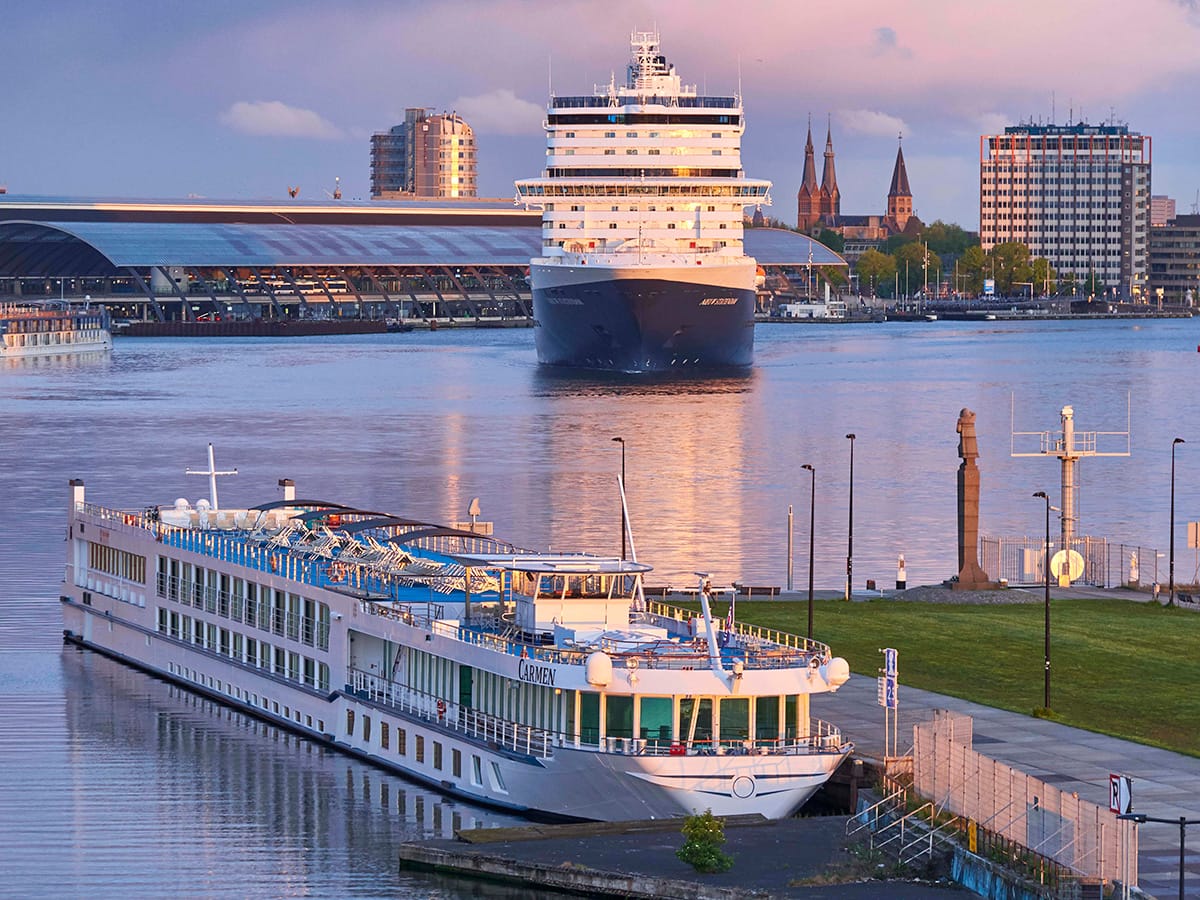
Indeed, criticism of tourism in general and cruise tourism in particular has moderated in Bruges. But not in Amsterdam, where the inhabitants have made it clear that tourism must change. Last summer, a motion by the centre-left liberal party D66 to ban cruise ships from the city centre was passed with a large majority. The city’s cruise terminal will now have to be relocated away from the centre.
“This discussion has been ongoing for many years,” said Dick de Graaff, director of Cruise Port Amsterdam. “Perception is an issue. The majestic ships docking at the terminal give the impression that thousands of guests are flooding into the city at once, though this is not the case. On the contrary, cruise passengers are respectful visitors to the city. They are often older visitors who visit museums and take canal tours. In 2023, the number of transit passengers in Amsterdam was 130,000. Some remained on board, some went on excursions outside the city, and some explored the city independently.”
De Graaff believed that the number of passengers exploring the city accounted for only about half of the total arrivals (185,000 in 2023). “The other half are turnaround passengers. They typically stay overnight in Amsterdam before their cruises. This accounts for about 60 per cent, approximately 45,000 hotel stays, annually. Considering the total number of visitors and overnight stays, this is a relatively small percentage.”
The city is closely scrutinising its policy on cruise. “Currently, there is a comprehensive study under way examining all aspects of cruise tourism in Amsterdam, which will be included in a report that the alderman will base his advice to the municipal council on. Relocating a cruise terminal cannot happen overnight,” said de Graaff, who expected that if the outcome of the study suggested a new location was necessary, it would mean a very careful and drawn-out process.
The Croatian city of Dubrovnik was once averse to cruise tourism. “Previously, in Dubrovnik, public opinion was quite negative, primarily due to the large traffic jams on busy cruise days, with sometimes up to eight ships [per day],” said Jelka Tepšić, deputy mayor of Dubrovnik. “In the past seven years, the City of Dubrovnik completely changed the public opinion about cruise ships visiting our city. Determined to turn Dubrovnik into a leader in sustainable tourism in the Mediterranean, the city started developing the strategic project named ‘Respect the City’ in 2017. We began tackling the challenge through various measures to relieve traffic congestion and implementing smart city solutions. In a relatively short period, we began managing our destination and are now moving towards sustainable tourism, to the great satisfaction of visitors and citizens alike.”
From the very start, the French port of Le Havre seems to have a positive perception of cruise tourism and warmly welcomes cruise ships calling. There is a good reason for this. “We can really build on the legacy from our transatlantic past. The people of Le Havre have retained a strong attachment to their maritime history,” said Valérie Conan, director of Cruise Le Havre. “Due to its geographical location, ship movements can be observed from the beach and along the extensive promenades. Ship arrivals and departures are always visible, even from the MuMa (Museum of Impressionism). Ships are part of the daily life of the inhabitants. Port activity and shipping are deeply rooted in the DNA of the people of Le Havre. The port sector represents 30,000 jobs.”
Dialogue is key
“Communication with all stakeholders is key,” said Vandenkerkhove, who liaises with the cruise lines and tries to persuade them to spread the calls throughout the week. “Ideally, we have calls from a large ship and a small luxury ship, rather than two large ships, on the same day. We continuously invest in dialogues. For example, Zeebrugge will become a CLIA member with the aim of creating a memorandum of understanding for a better dialogue among cruise lines, the city, and the port.”
De Graaff is convinced that it is important for the terminal and the shipping companies to tell the right story about ocean cruising. The number of visitors from cruise ships is small when compared to the total number of tourists the city receives, and the effort the industry makes on sustainability is progressing rapidly.
“Additionally, we aim to build a constructive dialogue with the municipal council. We are willing to help finding solutions,” said de Graaff. The Amsterdam municipality aims to discourage tourism that leads to disturbances and sets a maximum limit on the number of visitors in order to maintain the city’s liveability standard. For this purpose, it has implemented various measures: dispersing tourists throughout the city, converting hotels into residential buildings, earlier closing times for cafes, introducing a ban on cannabis use, and limiting river cruises. “If the number of visitors exceeds 18 million per year, the municipal council will intervene,” said de Graaff.
A lesson on dialogue can be learned from Dubrovnik “The city reached out to CLIA to collaborate on managing cruise ship arrivals,” said Tepšić. “As a result of this partnership, the city successfully implemented measures to regulate the number of cruise ships and passengers. A limit of 4,000 passengers at any given time was agreed upon, along with longer stays in the port. Through meticulous planning of cruise arrivals and departures, Dubrovnik has been able to mitigate excessive crowds during the tourist season.”
The emphasis is on working together, understanding each concerned party’s needs and expectations. “The cooperation of all stakeholders is very important,” said Tepšić. “The main focus is on the needs of the citizens, with the goal of achieving a balance between everyday life, economic activities, and the needs of the tourism sector, while preserving the protected cultural-historical heritage.”
Dialogue is also key to Le Havre’s cruise business strategy. “In Le Havre, we held a public enquiry to gather comments and suggestions from residents as part of the process of the building permit application for the new terminal. That way, locals are more involved,” said Conan.
Of course, from the perspective of cruise lines, cruise tourism can only be good for the city. MSC Cruises, for example, is convinced that cruise ship visits can make a positive impact on the destinations. Dialogue and cooperation are at the heart of its strategy also because it understands their importance.
“We are committed to making a positive contribution to the communities we interact and engage with,” said Linden Coppell, VP sustainability and ESG, MSC Cruises. “We take our responsibilities very seriously. After all, without the communities we visit, our guests wouldn’t be able to enjoy the rich experiences cruising offers. This an area that the whole industry must work together to ensure consistency and a coordinated approach, to make local communities recognise all the benefits we can bring and minimise the impact. We have a proven track record of making a positive contribution to the destinations we visit, and this is a result of working in partnership with tourism bodies, communities, and local authorities and officials. We can provide our guests the chance to experience the wide variety of offers provided by the destination community, which contributes to us making a positive impact on the places we visit.”
Invest in sustainability
To win hearts and minds of the local community, the industry must invest in sustainability. The fact that cruise lines have been a leader of decarbonisation and related technological advancements is a message that must be communicated effectively to the wider public.
“Are ships polluting? It cannot be denied that ships do have emissions, although this is very limited compared to total air pollution,” said de Graaff. “The cruise industry is at the forefront when it comes to sustainability. In Amsterdam, from 2025, the terminal will have shore power for ocean cruise ships. The sustainability of passenger shipping is improving rapidly, too.”
In 2024, Zeebrugge will have 40 days with two large ships calling on the same day. “These increased volumes require us to invest seriously,” said Vandenkerkhove. “The merger with Antwerp into Port of Antwerp–Bruges has certainly helped creating a strong framework for investments. The port invests €17 million for two cold-ironing stations. The merger paves the way for alternative fuels, too.”
What is also important is to get the local community directly involved in the development of cruise business, building facilities with their interests and perspectives in mind, as in the case of Le Havre.
By 2025, a carbon-neutral and energy-efficient cruise port will be inaugurated on the Pointe de Floride in Le Havre. “This major development project presents a tremendous opportunity to re-establish the connection between the people of Le Havre and this exceptional site, which offers unique views of the activity of the port of Le Havre and the coastline of the reconstructed city centre, which is listed as a UNESCO World Heritage Site,” said Conan. “The project aligns with the transformation of former port spaces into public areas, ideal for walks with unique panoramas of the sea and port activity and facilitating interactions between cruise passengers and the local community.”
Le Havre cruise initiatives clearly benefit the local community socio-economically. What is also important is to communicate this message to the public. “For several years, local businesses and tourist sites have observed that cruise passengers constituted an important clientele. The season has extended, and there are now cruise calls year-round. The local economy benefits from them throughout the year,” said Conan.
Dialogue is therefore the indispensable gelling agent in building trust, ensuring undistorted perceptions, and sharing views on the interests of cruise business and the destinations. “Amsterdam, Bruges, and Ghent are not unique in their discussions concerning the value of ocean cruising. Sustainability and the influx of many visitors are concerns of several other cities, too. It is up to the ports, shipping companies, and all stakeholders to communicate clearly, honestly, and transparently to the public the economic value of cruising, as well as the advancements being made in green initiatives,” concluded de Graaff.

