

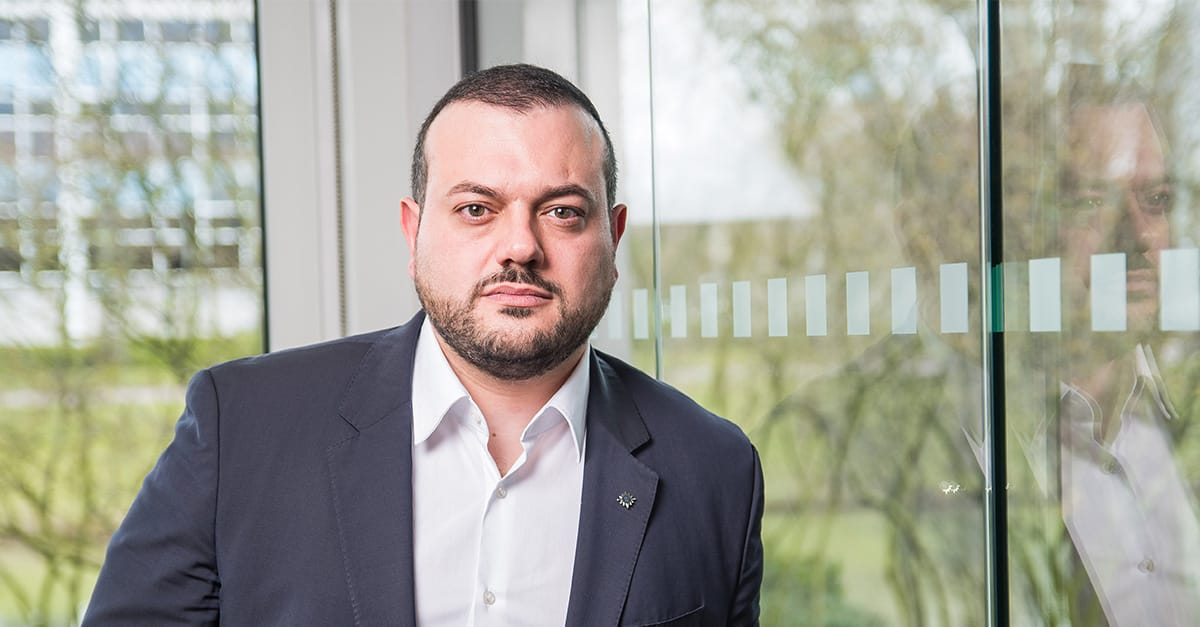
Following the recent industry-first net-zero maiden voyage and the lavish naming ceremony of MSC Euribia, MSC Cruises’ 184,000-gross-ton, 6,330-passenger newbuild,CruiseTimes editor Frances Gannon spoke on board to Antonio Paradiso, the company’s managing director UK & Ireland, about achievements, challenges, and strategies.
Frances Gannon: MSC Euribia is undoubtedly a giant step in MSC’s decarbonisation journey. How challenging has it been so far from the perspective of cost and technical obstacles?
Antonio Paradiso: Not sure “challenging” is the right word. It is more about the time and the costs associated with this journey, because we first started this journey in 2008. People think that we started talking about sustainability today, but it goes back to 2008. So what I’ve seen that has changed over the years is the length of time we’ve dedicated to this.
In 2008, we probably dedicated 5 per cent of our time on sustainability; now I can say that we are talking about sustainability every day. The challenges do not come from within our organisation or internal processes – the challenges are more to do with the outside world. It’s what’s happening out there.
Sometimes I believe maybe we’re ahead of the game, especially when it comes to dealing with certain forms of fuels and certain infrastructures. I’m under the impression that not everyone is keeping the same pace out there.
We can have the best ideas in the world, the best vision in the world, et cetera. We can do everything when it comes to the ship itself regarding the sort of fuel we use, the sort of materials we use and how we recycle this, how we recycle that, the sort of paint we need, et cetera. But when the ship is docked in the port, if you want to cut all emissions completely, we need shore power. We need a plug and a socket in place, like [for recharging] an electric car. There are still only very few ports that can provide such an option.
So the challenges are more to do with what is outside of MSC’s control. Being sustainable is not cheap, that’s the irony. You want to be greener, but you end up spending more money, and I appreciate that not everyone probably has the same commitment and dedication to the vision as we do at MSC.
FG: We published an article on shore power in the last issue [issue 20, available on cruisetimes.net]. The problem is that the ports have just had lockdown and they’ve lost income. They have to look at their investment plans again. They have to approach their governments for funding. It’s a slow process. It doesn’t happen overnight. Renewable shore power is the big challenge. Some ports are so small that they could never provide shore power.
AP: Indeed, we are aware of this. We are also working [towards] one day not to rely on shore power. The future ship should become self-sufficient. This is another option we are considering because, you are right, there are some ports, like Southampton and Hamburg, that know what to do and can invest in such facilities, but there are minor ports which will probably never invest money and time in developing that. This means that we’ll need to fill that gap by becoming more and more self-sufficient, and I think that’s exactly what MSC is trying to achieve here.
It is also down to the will and dedication of each and every destination. There are destinations that are not interested in developing tourism, and there are others who would say, “Okay, I believe this will definitely be worth it for my community because we want to attract cruise visitors, so it’s worth investing in this.”
We can’t really change people’s minds on this, but we do need to know who’s doing what, because we’re already working on itineraries for the next four, five, and six years. In certain countries, we need to respect certain parameters that are set to local requirements, otherwise we can no longer go there. So we are restricted by different requirements and provisions in different countries we visit. That’s why I said that, for us, being self-sufficient is the end goal, because depending on others is not always ideal.
FG: In reference to MSC Euribia’s just-completed industry-first, net-zero maiden voyage, clearly the crew were fully trained for this undertaking. Have there been any specific safety concerns relating to this?
AP: Honestly, not at all – not from the customers, the guests, nor from us. Actually, there has only been appreciation, I would say, because probably people are finally getting it. As cruise industry we have been talking about bio-LNG for years now. Questions are asked: Do they really have bio-LNG? Can they really buy enough bio-LNG? Well, we have. So that’s why we’re saying this is officially the very first [net-zero] voyage.
So far, the main sentiment probably has been appreciation and curiosity. I am really happy more people are curious now. They’re asking more questions, which is satisfying, because in this regard at least all that hard work is paying off. Sometimes you’re under the impression that, okay, we’re doing all this, but people are still not getting it. What has changed now is that I’m getting more and more questions on sustainability. For example, previously in an interview like this, 90 per cent of the questions would be about food, drink, and entertainment; now I can easily say 50 per cent is about sustainability. So you can see the change. It’s happening.
FG: There still seems to be a lack of understanding of how much the industry is investing in sustainability. There still is a negative feeling towards cruising in general, but I think that’s changing now. It takes a long time for the international media to see how much is being done.
AP: You may appreciate that we were the first ones to start a conversation with our customers on sustainability by introducing our brand-new TV commercial. In January, we became officially the first travel company in the world to go live with a TV commercial that’s all about sustainability. There’s no cruise ticket prices, no sales pitches.
Sometimes we also use technical and scientific data, but not everyone appreciates that. So in this very first TV commercial, which is available in two different versions, a 60-second one and a 30-second one, basically we start by sharing what we are already doing in terms of energy savings and recycling on board. We end the commercial with two very simple questions: Can we do it? Can we do better? The answers are of course we can, and we will never stop until we get there.
And we have seen the result. In the UK, our brand is now automatically associated with the key word “sustainability”. We know that, because we’ve done surveys whereby we don’t mention our brand name. Instead, we just show screenshots or a few seconds of the TV commercial. Everyone instantly associates them with MSC.
FG: How soon do you think you will be able to extend this net-zero voyage concept to regular commercial cruises, and are all the necessary technologies and operational know-how sufficiently in place already?
AP: Okay, this is a tough question, because the timings are not down to us. The reality is that bio-LNG is not really commercially available [in sufficient quantities]. So that’s why it’s tough to answer that question, because if we could, we would be buying it every day, but unfortunately there is only a small amount of bio-LNG currently available in the world. So commercially we’re not there yet. All I can say is that this is already our second ship that is ready to use bio-LNG, and we are already implementing the best technologies in all the other aspects of the journey. Recycling and wastewater management systems, et cetera, are already available on board our ships. We are planning to retrofit the older ships in order to accommodate such new technologies. The new ships are already coming with the best-in-class technologies.
Regarding the fuel, that is tough to say, because the next two ships will definitely be bio-LNG enabled. For the rest of the fleet and all future ships, maybe we’re going to go down the hydrogen or the battery route, because LNG requires a lot of space.
We are definitely retrofitting probably about 85 per cent of the elements already available. But regarding the fuel, I cannot yet tell what we will do. After this second LNG ship, we’ll have two more and the options for a third one. Here we are also buying ourselves some time, because we are developing other projects as well. So maybe five to six years down the line, bio-LNG will no longer be the right solution.
FG: We’ve always heard that because of carbon emissions, you won’t get net zero if you’re using LNG.
AP: Exactly. That’s why I say bio-LNG is part of the journey; it’s not the destination. We’re being brutally honest about it, because people think bio-LNG is like a magic solution for all of our problems. It is not; it’s just part of the process.
FG: Since you mentioned the space requirement earlier, will MSC keep on building bigger ships, or will you reduce future ship sizes?
AP: Yes and no. With the contemporary MSC Cruises brand, I think we would always have ships of this size. Why? In contemporary cruising, we mainly attract couples and families who would like to have many options in terms of entertainment and facilities. You can never build an aqua park on a smaller ship. It’s impossible – it would occupy half of a small ship. So we will continue to have these big ships. But at the same time, for our luxury Explora brand, we will be building much smaller ships, which will visit destinations that bigger ships can’t go to.
I always say that there’s a cruise for everyone, and also the size of the ship is always down to the personal choice and the personal taste of each customer. There are customers that just don’t like small ships, because there isn’t much going on. Some people may find them a little too low-key in terms of entertainment and buzz. There are others who prefer a little more privacy and intimacy. That’s why even on a big ship we have the yacht club. We have customers who want to be on a big ship but would spend 99 per cent of their time in the yacht club. They like to have the options.
We’re going to be doing both. That’s the answer. We will have the smaller ships for certain customers and large ships for the mass-market segment.
FG: So you are going to continue building big ships.
AP: All I’m saying is, watch this space.
FG: I just checked the orderbook. I think there won’t be any new contemporary ship due for delivery in 2024.
AP: Then in 2025 you’ll have a few more. There are two cruise corporations that have got absolutely no new ships from 2026 onwards.
All I am saying, as far as MSC is concerned, is watch this space, because we are a global brand and we are very well established in 70 countries around the world. This is where we are different from the Americans. The American brands are just [focusing on] the US and a couple of other markets. We are big in 70 countries, and what we’re seeing is that we don’t have enough capacity for the demand we are seeing around the globe. That’s the truth – despite our incredible growth in the past 20 years, and we’ve been delivering more ships than any other brand, it is still not enough.
FG: Perhaps the biggest challenge is the high cost of net-zero fuels. Will MSC’s net-zero cruises be more expensive, and by how much?
AP: Generally speaking, it’s not only the fuel. There has been a general increase of costs, starting from supply chains, and I am not just talking about fuel supply, I am talking about everything. So the prices have already gone up. Then, of course, there will be differences according to the markets we sell to. In certain markets we need to be a little bit more affordable, and in some other markets we can afford to be a bit pricier.
I can see the price trajectory going upwards, because there’s an increase of costs and at the same time we need our own margins. If you want to tick all the boxes, be green, have the best entertainment, have the best food, have the best this and have the best that, that comes with a cost. So the prices are going up. I’m not sure you’re going to see again the prices you’ve seen in the last couple of years in terms of last-minute offers. Maybe one or two brands will continue to be aggressive on the price-cutting front, but that’s not our strategy.
But we believe in rewarding early bookers. So the idea is, if you book one or two years in advance, you get the best deal. Once the early-booking phase is over, our strategy is that, week by week, we increase the price a little bit as the ship starts to fill. I will lose credibility if I ask people to book now and then six months down the line I offer lower prices. People will also book later and later.
To answer your question, yes, the prices will be going up, and they are already higher than last year and even higher than those of 2019. I don’t expect a 300 per cent increase. All I’m saying is that, if I look at the prices right now, I can generally say these are 20 per cent higher than the previous years.
You can see this pretty much across the travel industry, because, I don’t know if you have noticed, the hotel rooms now are more expensive than what they used to be. We’ve seen that the cost of living has increased. This is reflected in everything.
FG: Will the passenger experience and comfort on board be different on an MSC net-zero voyage, given that many energy demand outlets on board such as air conditioning fan speed will be reconfigured and minimised?
AP: I would say no. It is just the way we use things on board the ship is changed. This probably won’t even be noticed by the customers, and, let’s be honest, we have LED lighting all over the ship. People don’t know what action we take behind the scenes when they move from one venue to another. One of the changes we’ve made is that previously in certain venues the light used to be on from the morning till the evening; now when that venue is not in use, the lights are automatically switched off. This should not affect customer experience negatively.
The answer to your question is no, the customer experience has not been affected at all. Only what we’re doing behind the scenes is changing. How will the customers know if we use LNG or diesel, if they have no access to the engine rooms?
FG: Representatives of the shipbuilder Chantiers de l’Atlantique and other experts were on board during the maiden voyage. Besides the efficiency, safety, and customer experience of the ship’s performance, what else would they be looking out for?
AP: The reason why at least in the first couple of cruises in the first couple of weeks we’ll still have these people on board, especially the maintenance team, is because there could be some finishing touches or little things that we haven’t finished on time. It’s more about the interior design thing.
In terms of the fuel performance, they are just observing and collecting data, because the data we are collecting will give us a better picture of how we can do it better in the future, especially when it comes to costs and fuel consumption. That’s the most important thing.
In fairness, we already analyse the data pretty much every week. This net-zero voyage is a first for us, so we want to understand, for example, if the ship was sailing at the right speed, maybe we could have travelled slower or faster. We were testing and collecting data all the time. What passengers might not have noticed was that we were changing speeds throughout the journey.
FG: Out of interest, will these data be shared externally?
AP: I don’t think so, if I’m honest, because we would be offering an advantage to our competitors.
FG: What is MSC’s next step after this voyage? Will you trial other green fuels? If so, when?
AP: The answer is yes. The crucial thing here is the viability and the availability of certain fuels. So our intention is to have as many trials as possible. That’s the answer.
FG: What about nuclear power? Is that also an option you are considering? I think Mr Vago or someone else at MSC said, in relation to Explora, that they were not ruling out the nuclear option?
AP: Let’s say it is less of an option compared to the others. Did we rule it out? No, we didn’t. But my gut feeling is that of all the options we are evaluating at the moment, it is probably the least credible one.
All I am saying is that, at MSC, we do not have the luxury of ruling anything out, because at the end of the day it’s always down to data, facts, and stats. So it’s not about how I wake up this morning and say, “Oh I think nuclear is sexier than that.” We’re working on many options, that’s the answer. Let’s not forget what we do for a living: we sell holidays. So the customer perception has a huge impact on what we do as well.

