As cruise industry veterans, insiders, and observers gathered in Miami in April for the annual Seatrade Cruise Global conference, few could have expected that the cruise industry, just four years after a global health pandemic crippled it, would come roaring back, better than ever.
By Aaron Saunders
No one doubts the resiliency of cruise, but the industry’s recovery has been nothing short of astounding. Revenue, particularly onboard revenue, is surging past expectations. Occupancy is up over 100 per cent for most lines – as much as 132 per cent for Royal Caribbean, which is seeing record demand for its newest vessel, Icon of the Seas. And consumer interest, particularly among new-to-cruise, remains high.
But unlike in previous years, when this demand was described as “pent-up” as a result of the travel restrictions imposed during the global pandemic, the messaging at Seatrade Cruise Global 2024 was clear: this is “natural” demand.
Natural demand driving results
“The concept of pent-up demand for cruising is gone,” said Carnival Corporation CEO Josh Weinstein during the Seatrade Cruise Global keynote address. “For the industry and certainly for us, the demand profile is unprecedented. Our outlook for 2024 [has] record yields, record demand, record passengers carried. And as amazing as that is, our bookings for 2025 are better than they were at this point last year for 2024.
“This is natural demand, because we all provide amazing experiences,” Weinstein concluded.
He has plenty of reasons to be optimistic. Carnival Corp’s earnings report for Q2 2024 highlights operating income of $560 million, five times the figure in 2023. Adjusted net income for the second quarter outperformed March guidance by nearly $170 million. The company’s cumulative booked position for the remainder of 2024 is the best on record in terms of price and occupancy. And consumer deposits on hand reached $8.3 billion, shattering the previous record by over $1 billion.
“We are very pleased with the continued acceleration of demand for 2025 and beyond, which builds upon the fantastic achievements in 2024 thus far. This positive trajectory is a testament to the successful execution of our demand generation efforts and the delivery of exceptional vacation experiences once onboard,” said Weinstein in a statement.
Royal Caribbean Group’s Jason Liberty echoed those sentiments, buoyed by the record-breaking launch of Icon of the Seas, the biggest passenger ship to ever set sail, just four months prior to Seatrade.
“It is the start of a new era of vacations, and we’re excited to see tens of millions of families and friends make their mark with memories they create together and on their own adventures without compromise,” said Liberty about Icon of the Seas.
Harry Sommer, president and CEO of Norwegian Cruise Line Holdings, referred to the “virtuous cycle” of cruising, noting that passengers who take a cruise and have a good time typically return home with stories to share about their experiences – which in turn helps to drive bookings.
“It could be friends, family, a neighbour, relatives,” said Sommer. “That positive word of mouth is really huge for our industry. The ubiquity of social media really helps in this endeavour.”
Lack of clarity on sustainability
The panel of CEOs also touched on sustainability, the watchword of 2023’s State of the Industry. While it continues to be an important benchmark for the cruise industry to work towards, conflicting regulations around the globe and the lack of a common, agreeable fuel source for future vessels continue to stymie the top brass in cruise.
“There is more opportunity for us to continue to evolve the technology that supports our ships and the infrastructure on land,” said Liberty. “Many parties here today help us reduce the amount of fuel we burn and emissions, but this only solves so much. We need to make sure we have fuel sources that allow us to get to net zero.
“We need fuel sources where we know where they will be, and what they are, and what is available to us is scalable and affordable,” said Liberty.
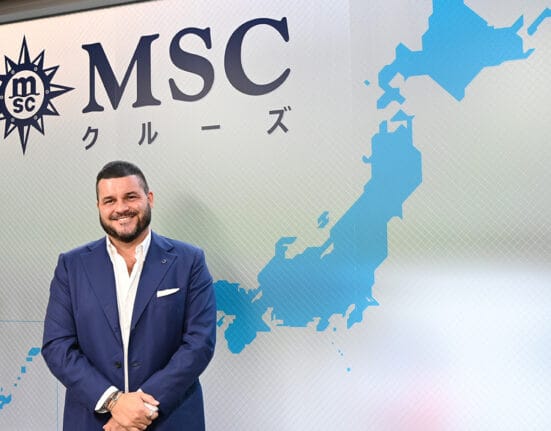
“The problem is, they are not doing it in line with the rest of the world – they are coming out with their own agenda, and we don’t have a global approach,” said MSC’s Pierfrancesco Vago.
Vago was referring to new regulations from the EU Emissions Trading System (ETS), which requires emissions reporting for all cargo and passenger vessels over 5,000 gross tons as of 1 January 2025. Under the plan, shipping companies must have an approved monitoring plan for reporting annual emissions. Companies must submit an emissions report for each vessel sailing within EU waters, as well as an emissions report for the entire company’s fleet, in total, that must then be verified by an accredited verifier. Companies then must buy – and use – accredited emissions allowances by 30 September of the following year.
While the EU ETS is designed to reduce emissions targets for passenger, cargo, and offshore vessels, the reporting requirements are onerous. This may cause vessel operators to look elsewhere for deployments and routing.
“This is a wider problem in the maritime, not just in cruise but logistics, supply, and cargo become uncompetitive if shipment is in Europe versus Northern Africa,” said Vago about the differing emissions standards between continents. “This needs to be looked upon and brought to IMO level, as IMO is looking to understand how to harmonise the approach in the global sense.”
Executives also touched on confusion about future issues that will affect not just cruise but also the broader maritime shipping industry.
A good example can be seen in ongoing discussions about alternative fuels, with cruise lines hedging their future newbuild bets on vessels that have hybrid fuel sources: LNG or traditional marine gas oil. Ships that are green-methanol ready. Ships that have capability for auxiliary battery banks onboard. Shipping giant Maersk has already committed to green methanol to power its future fleet. If successful, that technology could find its way aboard cruise ships in short order.
But, as always, source and supply of these alternative fuels remain challenging – and costly.
New technologies
On the trade floor at the Miami Beach Convention Center, things looked much as they always have: a strong contingent of worldwide ports and homeports clustered on one side of the venue, while suppliers and shipyards took up the “technical” platform on the other.
But towards the main entrance, the convention floor looked more like a technology or computer game convention. Vendors showed off apps, AI-assist technologies, virtual reality games and simulators, and other new innovations that are slowly, but surely, becoming part of the big ship cruising experience, particularly as mainstream lines seek to court a millennial, new-to-cruise audience.
That sort of thing is being embraced by cruise lines: media were invited to take a virtual stroll through MSC’s forthcoming MSC World America thanks to a pair of Apple Vision Pro virtual reality goggles that allowed them to “walk” the decks – a full year before the ship’s physical debut in Miami, scheduled for just after Seatrade Cruise Global 2025.
Innovation has never been stronger in the cruise industry. Lines, particularly those engaged in mainstream cruising, are in a race to blend successful elements of all-inclusive resorts and theme parks on land into a seagoing package that can attract the ever-lucrative new-to-cruise passenger. That means bigger waterslides, more elaborate features like the Bolt roller coasters on Carnival’s newest vessels, or an entire rethink of the cruising experience, like Icon of the Seas or the adults-only, big-ship vibe of Virgin Voyages.
More good news
After relatively announcement-free sessions since the pandemic, Seatrade Cruise Global’s 2024 edition saw several high-profile announcements from cruise lines.
MSC Cruises announced that its third World-class vessel would be called MSC World Asia, complete with an elaborate virtual steel-cutting held right on the trade floor.
Windstar Cruises announced the first expansion to its fleet in a decade, acquiring two new ships (one already in service, one still in the yard) that will debut in 2025.
American Cruise Lines announced two more coastal ships, the fifth and sixth in the line’s innovative Project Blue series of catamarans, to enter service in June and November 2024.
The biggest news was reserved for Norwegian Cruise Line Holdings, which announced a massive newbuild order for eight vessels. Four of these are 200,000-gross-ton vessels earmarked for NCLH that will debut from 2030 to 2036. Two additional 86,000-gross-ton passenger vessels carrying 1,450 passengers will debut for NCLH’s Oceania brand in 2027 and 2029, while two 77,000-gross-ton ships, carrying 850 guests apiece, are earmarked for Regent Seven Seas and will debut in 2026 and 2029.
Seatrade looks ahead
The optimism was palpable throughout all four days of Seatrade Cruise Global 2024. With metrics pointed in the right direction, there’s no reason to believe that the industry’s 2025 conference will be any less fantastic.
Cruising is back. The challenge now will be keeping up with its increasing popularity.