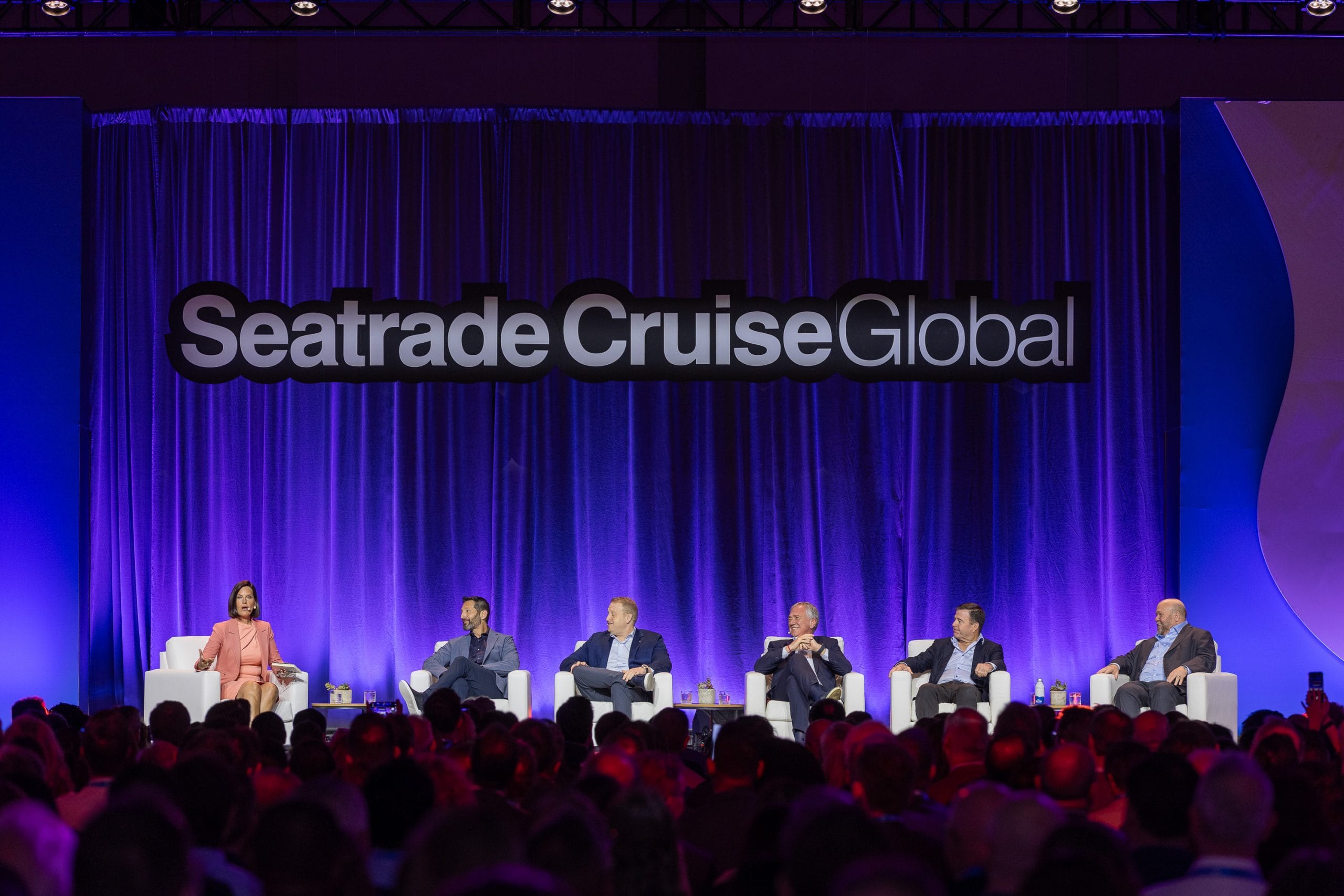
Seatrade Cruise Global, the largest gathering of cruise industry professionals, just wrapped up its 41st year in Miami Beach, Florida, this past week, revealing an industry that is booming – but one that is being shaped by challenges looming on the horizon.
With the industry’s orderbook remaining strong and passenger growth continuing its march into new territory, executives were quizzed on their opinions on a variety of world events, from the rising cost of fuel and the conflict in the Middle East, to the ongoing debate about marine fuels of the future. That led to some terse exchanges from executives during the opening State of the Industry address.
“Nobody asks us about oil when the price is low,” said Carnival Corporation CEO Josh Weinstein. “Fuel is something we need for our business. The focus for Carnival has always been ‘use less’. At the end of the day, if we consume less fuel, it is better for us and better for the planet.”
Pressed on whether rising oil prices will hurt Carnival Corporation, which does not hedge fuel, Weinstein acknowledged there was some risk there. “It’s true: this is going to hurt us more than it will others, just like it helped us the last few years,” he said. “The great thing about our business is it’s a very healthy business. We have a great balance sheet. We have record demand.”
Newcomer John W. Chidsey, who took the helm at Norwegian Cruise Line Holdings following the ouster of former CEO Harry Sommer, defended his relative lack of cruise experience, having most recently served tenure as head of fast-food retailer Subway.
“I would say I’m a turnaround guy,” Chidsey said when asked if there was a difference between selling sandwiches and selling cruises. “I really enjoy turnarounds, and I was on the board of this company [NCLH] for a while, but I look at it as, this is what I like to do. I think we can improve our execution; we’re not quite as aligned as we could have been; but to me it’s an exciting industry and I’m looking forward to doing yet another turnaround.”
Keynote moderator and CNBC broadcaster Contessa Brewer drew out a visibly annoyed Pierfrancesco Vago, head of MSC Cruises, when she asked him about cruise ships trapped in the Middle East as a result of the closure of the Strait of Hormuz.
“We’re living day by day; the situation is very fluid,” said Vago. “There is a lot of declaration that swings back and forth . . . the reality is [there are] five ships stuck in the Gulf. We’re talking to the IMO because we have a lot of seafarers that could be moved out of the Gulf. That would be a great story for everybody, for shipping in general.”
“The cruise industry has an incredible job,” Vago responded when pressed. “We managed to take out all of our passengers as well, and most of our crew, and now we are in minimum manning as well.”
All five vessels – Celestyal Discovery, Celestyal Journey, Mein Schiff 4, Mein Schiff 5, and MSC Euribia – were able to transit the Strait of Hormuz this past weekend. A sixth ship, Aroya Cruises’ Aroya, remains in the region, as it is normally homeported there.
Brewer asked about the possibility of an economic downturn as a result of tariffs, the rising cost of fuel and other factors, and the affordability of cruise.
“They [consumers] can afford us more than they can afford other things,” Weinstein answered tersely.
“What we’ve now shown for many, many years is incredible resiliency and demand,” said Royal Caribbean Group’s Jason Liberty.
“We’re better off as an industry now than we were 20 years ago,” Weinstein said. “A decade ago, we’d be talking about the mythbusting of cruise – how do we convince people cruising is good? Now we are not an alternative vacation. We are a vacation, and that sets us up very well for volatility.”
“The great thing about this industry is we adapt, we pivot, and we persevere,” said Weinstein, to thunderous applause from the audience.