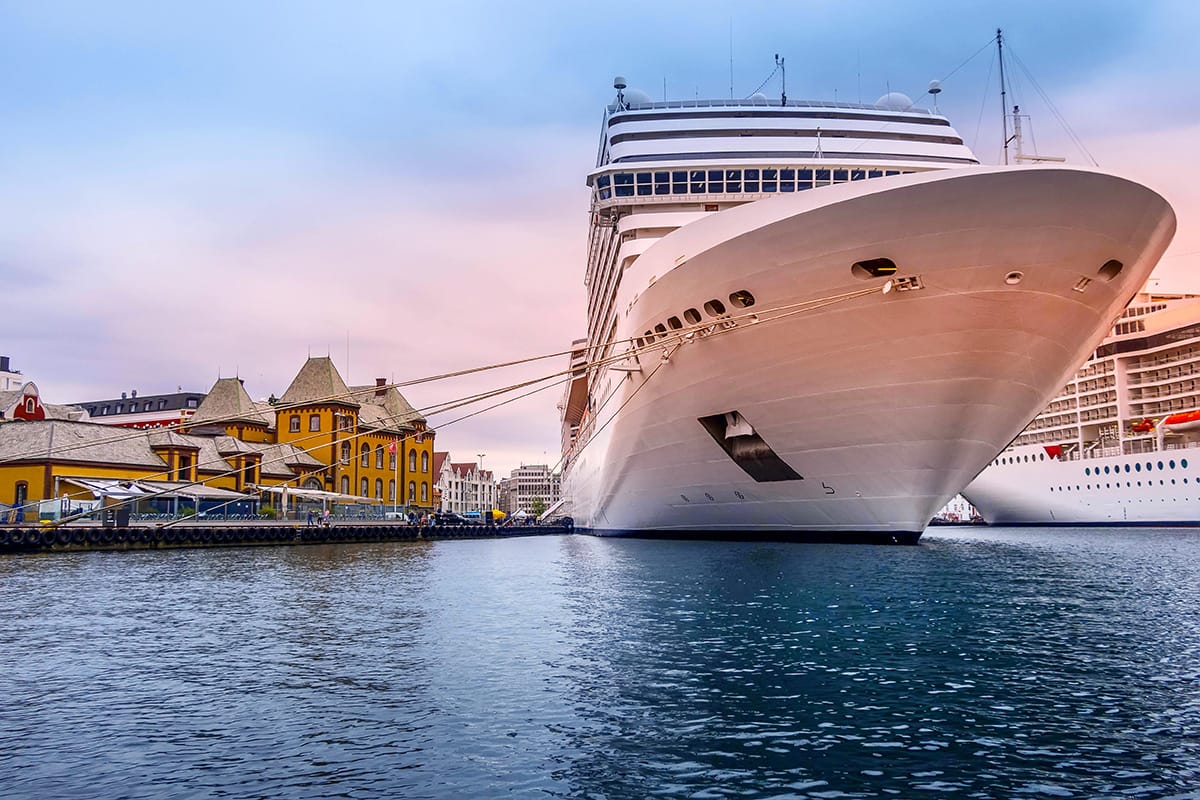
Cruise ships have become significantly bigger, and handling them in confined waters can pose challenges. A number of collisions and other incidents have taken place in ports: they have not led to loss of life or serious material damage, but they serve as reminders that big ships can be difficult to control in strong winds and currents when in confined waters. Design, operations, and training all come into play in keeping ships safe in these conditions.
By Kari Reinikainen
Against this background, it is interesting to find the master of Princess Cruises’ new 175,000-gross-ton Sun Princess praising the capabilities of his ship in a recent interview.
This vessel has 18,000 b.h.p. thrusters, which is 80 per cent more powerful than in the previous 143,000-gross-ton Regal-class ships. Sun Princess can push off the dock in 40-knot winds using its thrusters and Azipod propulsors, while the previous class of ships would find 25-knot winds challenging.
According to Per Nahnfeldt, general manager products – electric propulsion, Kongsberg Maritime, there are two principal approaches to look at the power requirements of thrusters, as far as wind conditions are concerned: the first is to use the average wind conditions in the region where the ship is intended to operate as the basis of calculations for power; the second is to use the known maximum conditions.
Some cruise ships built around the turn of the millennium received additional thruster power later in their lives when it emerged that the original installation had not been powerful enough. But an overly powerful thruster installation does not translate into an efficient use of capital.
Complex optimisation
Luckily, getting things right has become easier, according to Marco Bognolo, vice president of basic design at Fincantieri Merchant Ships Division. In recent years, ship design has changed radically, evolving from the days when propulsion systems and thrusters were primarily based on statistics and experience to current practices using sophisticated methods to assess performance well before the vessels are built.
“Today, manoeuvrability analyses are first carried out using computational fluid dynamics (CFD) tools, and then validated with scaled models. Computational capabilities now include simulating different design concepts, such as the effects of conventional shaft lines associated with rudders and stern thrusters, or alternatively, a podded propulsion system,” Bognolo told CruiseTimes.
In designing ships, many variables, such as balancing the power of side forces generated by the propulsion system and the bow thrusters, are considered to maintain course-keeping ability and avoid undesired rotational effects.
“Optimisation also involves determining the proper size and position of thruster tunnels to avoid suction effects that may reduce thruster efficiency, as well as estimating thrust reduction when the vessel is sailing at slow speeds,” Bognolo said. “The accuracy of our computational model extends beyond the underwater parts to include the aerodynamics of superstructures. While past calculations only estimated wind forces acting on the vessel’s lateral projected area, modern software allows for a thorough analysis of the actual three-dimensional shapes using CFD techniques. Subsequent model tests are conducted to validate the real forces generated by the wind at different angles and speeds.”
Initial calculations typically consider unrestricted waters and quasi-static conditions. But the effects of shallow waters, currents, tides, and dynamic interferences when leaving or approaching the quay are important topics to address during ship design.
Additionally, for specific ship types, such as expedition vessels, station-keeping capability is a key requirement, because these ships often need to maintain their position in areas where using an anchor is not an option. “Finally, and to add more complexity to the scenario, the initial design of passenger vessels includes the capability to predict noise and vibration behaviour also during manoeuvring. A portfolio of active and passive mitigating actions has been developed and is now adopted as necessary to ensure that required comfort levels for passengers are maintained,” said Bognolo.
Preparing for worst
There is also the possibility that things can go wrong at a crucial moment. “Generally, one of the biggest concerns for a cruise [ship] operator when manoeuvring in port is the risk of a blackout,” said Maikel Arts, head of strategic growth area, cruise, Wärtsilä Marine. “A blackout in port is a dangerous situation due to the loss of power in combination with the close proximity of other vessels and quay sides. This is often why cruise ships have more engines running than needed, for back-up reasons. However, the average load on the engines is so low that this has a negative impact on fuel efficiency.”
For this reason, Wärtsilä promotes hybrid systems to cruise lines, combining two methods of propulsion: a combustion engine and a rechargeable battery power system. This enables cruise operators to use the engine in the most optimal way, which is to provide the average power for manoeuvring and absorption of short load variations.
“Then in case of a blackout, cruise operators have the battery on standby, immediately providing power, so that the ship always stays under control whilst the crew get the other engines switched on. Ultimately, battery systems provide excellent back-up capabilities, which, for manoeuvring situations, provides the reassurance that they will always remain in control of the ship,” Arts said, adding that the ability to switch off the standby engines, which are running on idle, in turn reduces fuel consumption and emissions and increases operational efficiency.
Equipment manufacturers respond to the demand from the cruise industry by offering more powerful thrusters. The increasing size of cruise ships has meant that more power is needed for a vessel to manoeuvre. “Whilst this can generally require more thrusters, manoeuvrability can also be achieved with better thruster optimisation,” Arts pointed out. “At Wärtsilä, for example, our tunnel thrusters cover the biggest, longest vessels on the market, and are sufficient to keep the largest vessels under control by providing 22,000 kW of tunnel thruster power. This gives cruise ships the manoeuvrability required in ports by guiding the movement of a vessel, all while ensuring accurate station-keeping.”
However, tunnel thrusters, if not considered properly during the design process, can have a negative impact on the hull, from a fuel efficiency perspective. This is important to consider, especially with cruise operators under pressure to meet increasingly strict regulatory requirements.
Design technology helps
Tom Strang, senior vice president of maritime affairs at Carnival Corporation & plc, said that in many ports with confined waters, the company’s ships relied on local maritime pilots who had extensive knowledge of the area and its waterways to provide additional navigational expertise, further enhancing the safe operation and manoeuvring of these ships.
But technology also plays a vital role. “To counter the increased hydrodynamic resistance and windage which otherwise affects the ship’s speed and manoeuvring characteristics, we commonly use Azipods on our ships to provide greater lateral manoeuvrability compared to traditional fixed propeller and rudder configurations,” Strang said. “Azipods provide low-speed propulsion through a 360-degree rotation, offering exceptional manoeuvrability, including enabling the ship to turn on the spot, move in any direction (even sideways), and maintain precise positioning – all vital for larger ships operating in confined spaces such as ports and narrow waterways.”
Overcoming these manoeuvring challenges also requires greater lateral power, and we have seen a proportionate increase in the power of bow thrusters. “The additional power improves low-speed manoeuvring in port, allowing the captain to turn the vessel to port or starboard side without using the main propulsion mechanism, which requires some forward motion for turning, making it an incompatible option in very confined spaces,” Strang continued.
Bridge design has also developed considerably in recent years, with ergonomics playing a key role, as well as improvements in equipment, all aimed at providing the bridge team with more effective and efficient tools to handle the cruise ship of today. “Modern ships are equipped with advanced navigation and control systems that integrate radar, positioning systems, and other sensors,” Strang said. “These systems, other real-time data, and the continuous monitoring of weather (including wind strength and direction relative to the ship), tides, and currents are vital in assisting captains in making informed decisions.”
Collectively, these solutions address the unique challenges of operating large ships safely and efficiently in and out of smaller ports. They often reduce or eliminate the need for tug assistance, even in the most confined ports.
Simulator training
Side by side with design and technology, training also plays a major role in safe navigation of ships in confined waters. “From a training perspective, similar to the airline and other safety-critical industries, we require our bridge teams to regularly train using simulators that replicate a wide range of real-world scenarios, including the challenges of manoeuvring large ships in small ports and narrow waterways,” Strang said.
Regular and recurring practice in Carnival’s Center for Simulator Maritime Training (CSMART) Academy gives bridge and engineering officers a robust, continual learning experience using the industry’s most advanced simulator equipment, technology, instructional tools, and curriculum.
The CSMART simulators can virtually transport officers to 60 ports around the world, to give them real-world experience and training in the intricacies and challenges of navigation. “They also provide a wide array of scenarios and sea conditions, including ship traffic, aircraft interference, weather events, and wildlife circumvention,” said Strang. “The result is bridge and engineering officers with the critical thinking, problem-solving, and decision-making skills to tackle any challenge, including manoeuvring in smaller ports. It should also be noted that we routinely invite pilots to attend simulator sessions – especially when a new class of vessel or new port is being assessed.”
All bridge officers at MSC Cruises also undergo regular simulator training at one of the company’s training centres. This allows them to refresh their skills, discuss challenging scenarios, and go part of the way towards performance evaluations that can lead to promotion.
“We have in recent years comprehensively recorded manoeuvres of every one of our vessels in ports all around the world. The data is stored in an internal system and is accessible to shipboard teams to review historical events to help them with planning prior to entering a port, especially for the first time,” said Captain Pier Paolo Scala, VP global port operations at MSC Cruises. He pointed out that strong winds, even for just a few minutes, can have a seriously negative impact on a cruise ship irrespective of its size, but that a larger vessel is more susceptible to such challenges.
“With wind speeds of up to 30 knots, ships will be fine with the appropriate number of mooring lines and bollards at the port,” said Scala. “Above 30 knots the ship will have to start the thrusters and propellers, and at 30–40 knots one or two tugboats will need to be in situation to help with the operation. We take a very conservative and precautionary approach with wind conditions. If its speed exceeds 20 to 25 knots, we start all the vessel’s pods or bow thrusters, provided that the port has the appropriate infrastructure.”
Manoeuvrability is one of the more critical points in the design process for a new class of vessel. The water and air draughts of a vessel are extremely important. Factors such as the shallowness of a port channel, the turning basin or a bridge can mean that a vessel class is restricted in its itineraries in particular parts of the world.
As is often the case, advances in technology help make operations safer. But ultimately it is the people in charge who operate the technology, and their skills and competences play a crucial role in safety.