For maritime companies, the real issue is not zero carbon, it is figuring out how it changes the business and what to do about it.
By Dr Martin Stopford
Decarbonisation will probably develop in waves, as the various technologies become viable. Most of these waves will be evolutionary, allowing well-run companies to take the transition one step at a time. But some waves will be disruptive, calling for a different business model.
In the 1960s, hundreds of cargo liner companies faced this sort of disruption when unitisation, accompanied by the loss of passengers to airliners, transformed the business. The result was devastating, but it resulted in the highly successful container networks and cruise businesses that we have today. Joseph Schumpeter, a leading 20th-century economist, named this “creative destruction”.
Dealing with decarbonisation
There are three useful tactics for working through these waves of change. The first is to be realistic about how change will develop, and to find ways to deal with disruptive elements. Adapting to a new business model is better than struggling as the old business fails. The second tacticis to look for ways to surf the tsunami of change, so that the company ends up with a better business. The third is to look for new ways to add company value, then find the technology to make it work (i.e., start with the value added, not the technology). From this commercially solid base, change can be managed.
Since shipping is not a homogeneous market – it has at least 20 different segments – there is not a “one size fits all” decarbonisation strategy. Each company must figure out the best way to move forwards, but all face the same three green-energy options: green fuels, carbon capture, and nuclear fission.
Step 1: Green fuels – a small step backwards
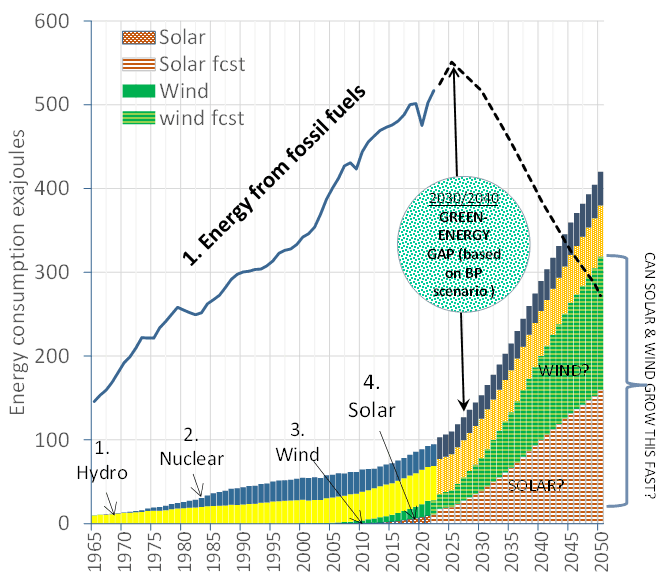
Although “green” methanol, ammonia, and maybe hydrogen do not add carbon to the atmosphere when used in slow speed diesel (SSD) engines, they are poor substitutes for fuel oil. They will also be expensive – several thousand dollars a tonne, and hard to get, at least in the next few years. Supply will take decades to develop, as the chart shows (based loosely on the BP Energy Outlook 2023 “Accelerated” case).
Supply does not match fossil-fuel consumption until 2040. Until then, supply will be limited. Electric cars are already in the queue and have a big appetite. In 2021 gasoline energy was about half the world’s electricity production. So green fuels may look like an easy option, but their high cost, lower efficiency, and some technical disadvantages make them a step backwards for the businesses using them.
Step 2: Carbon capture – a small step sideways
A second option is to keep using heavy fuel oil, or better still LNG, and capture the carbon. This is established technology, but it is still being adapted for shipping. As one shipping CEO put it, it’s not a silver bullet; it’s the same sort of technical challenge as water ballast management. Of course, shipping companies will have to find a home for the CO2, and the volume will make this challenging – over three tonnes for every tonne of fuel oil burned.
It might be a good fit with LNG fuel, which also needs refrigeration. Reducing carbon volumes by slow steaming would help, a strategy that might work for older ships with low capital costs. Maybe the CO2 could be sold on to methanol plants. So this looks like another useful step to zero, especially for existing ships, but it is a step sideways rather than forward.
Step 3: Nuclear energy – big step forward, or a step too far?
The third option is nuclear fission. If the name makes you nervous, change it. Whatever name you use, nuclear fission is the only zero-carbon option with the potential to outperform oil.
Modular nuclear reactor technology is being developed, for example by TerraPower in the US and by Rolls-Royce in the UK, and would be suitable for commercial marine use. These molten salt reactors (MSRs) use salt heated to 700°C as the heat exchanger. The nuclear fuel is dissolved in the molten salt, which circulates like water.
Unlike the scary pressurised water reactors, MSRs work at ambient pressure, which makes them much safer. If a pressurised water reactor-casing fails, the internal pressure blasts out a plume of radioactive steam (like breaking an aircraft window). But if the reactor-casing of an MSR unit fractures, there is no pressure. As the salt gets hotter, the reaction slows and any liquid salt that seeps out cools and solidifies. The rest drains into a tank below the reactor and solidifies. All of which makes the risk more manageable.
Will it work? Of course there are question marks, but this is established technology. In the 1960s a small MSR ran for a few years at the Oak Ridge National Laboratory in the US. TerraPower has a test facility running and expects a prototype marine reactor in 2026, followed by a commercial version in the early 2030s. The supply of enriched fuel, which is currently produced only in Russia, is a problem that can be solved by investment – the US government has a programme. Marine units are expected to range from 20 to 70 MW, with an all-up weight of less than 5,000 tons. If it works, this would be a new step for commercial marine energy, not just a substitute for heavy fuel oil.
The final wave
So that’s it. The job must be done, and most of the green technologies above will be used by companies in one way or another. But discouragingly, the result will mainly be an expensive step sideways, rather than a revolution. The exception is nuclear energy. Shipping operates vessels big enough to accommodate small modular reactors (SMRs), and this technology has “ships” written all over it – no way cars and trucks! It solves the CO2 problem, and it opens the door to abundant energy, just like oil did in the 1960s.
Run by companies with vision and efficient digital systems, the sky is the limit (well, maybe flying cruise ships would be a step too far!). For example, how about themed cruise developments replacing tired tourist towns with a network of theme villages, designed just the way customers want them and powered by SMRs, from which battery-powered cruise ships recharge. It would be a sort of maritime Las Vegas, scattered across clusters of islands, between which the all-electric cruise hotels glide gently, disturbed only by the waves of money rolling in.