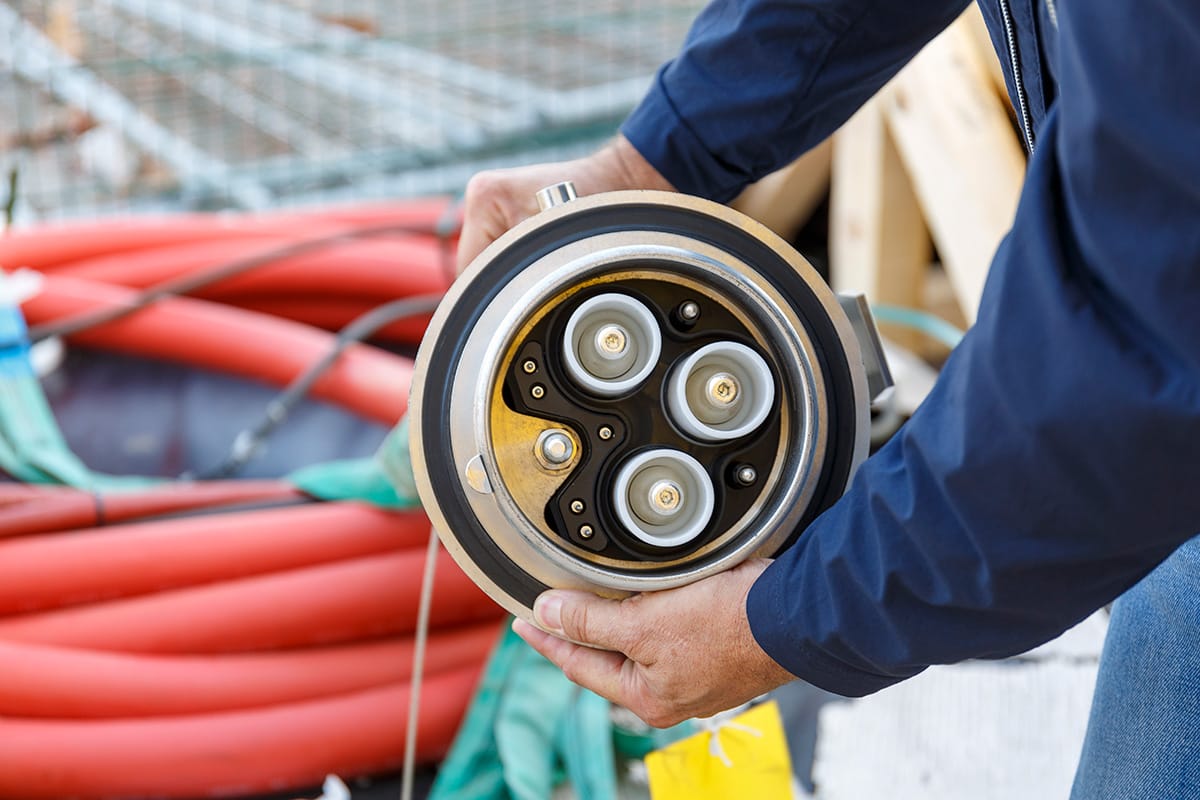
For a cruise port, whether to install shore power is a complicated question. The level of investment required is high; the local grid may not be able to cope; the regulatory framework can be confusing. Shore power is only a small part of a bigger picture.
By Susan Parker
The conversation about onshore power supply (OPS) has ebbed and flowed over the last three decades. The EU TEN-T (Trans-European Transport Network) scheme mandates that all major seaports must install OPS by 2030. This is causing a flurry of activities.
There is no doubt that OPS installation is a costly exercise. To make it happen, ports need deep pockets and preferably outside funding or subsidies, not to mention sufficient grid supply.
For many, this is driven not only by regulation but also by the wish to promote the well-being of port communities. An example of this is the city-owned Portsmouth International Port (PIP) in the UK, which will have a total of 16 MW of OPS available on three berths by April 2025.
“The rationale for Portsmouth is for the welfare and benefits of the residents,” said Ian Diaper, commercial manager of PIP. “They want to see a successful port, but also a very sustainable and environmentally friendly port. The aim of the Portsmouth City Council is to be carbon-neutral by 2030, not just the port but ships that use the berths, too. So, to do that, we have to offer the ability to plug in. It is not all about profit; it is also about relationships and the wellbeing of the residents.”
From the cruise line perspective, MSC Cruises began looking into OPS back in 2016, six years before it could actually be used on ships. “It is for environmental and reputational reasons in equal measure,” said Linden Coppell, MSC’s vice president for sustainability and ESG. “At the end of the day, we want to have a good relationship with the places we visit, particularly in those places where they see local air quality as a concern. It is important that we show we are helping to address that. We know it’s beneficial for us and the communities.”
MSC is committed to “taking OPS wherever it is available, regardless of cost,” Coppell said, adding: “We hope and expect it will be offered at a reasonable price and that any additional cost for the port itself is minimised.”
At present, those MSC ships that are OPS-ready can plug in at eight ports in Northern Europe as well as Valletta, Los Angeles, Shanghai, and Shekou. Indeed, it was the LNG-powered MSC World Europa that inaugurated the OPS system in Valletta in July – a €33 million investment co-financed by the European Funding Connecting Europe facility.
Europe leads
Northern European ports lead the world in OPS investments. Stockholm and Oslo offered their first connections in September 2024, to TUI Cruises and AIDA Cruises, respectively. In early October, the Norwegian government announced that it was providing NOK 100 million (€8.4 million) for OPS facilities in Flåm. By 2025, Port of Kiel in Germany, which reached the milestone of 100 cruise ship plug-ins this season, will have invested €55 million in developing its onshore power plants.
In France, Haropa Port is investing €40 million in OPS on three quays (13 MW each) in Le Havre for completion in 2025–26. €13.6 million of this is invested in accordance with the government’s France Relance plan and €900,000 as part of Research Fund for Coal and Steel.
“OPS is mostly available in northern Europe,” said Lucienne Damm, head of sustainability at TUI Cruises. “There are not many ports with OPS in southern Europe yet. We have connected 71 calls in northern Europe this summer, compared to about 50 last year. Now, this [region] really is a success story.”
Coppell said that more south European ports would come online with OPS in the next couple of years in compliance with the EU’s upcoming 2030 regulations. “We do know that some of our key ports – Barcelona, Genoa, and Marseilles, for example – will become operational in 2025–26,” she said. “Everyone is getting more comfortable and confident in it. For every port we go to, it will only get easier going forward as we get more used to it.”
Cruise Lines International Association (CLIA) states that there are 16 ports in Europe that provide OPS today, with 21 having funding and plans in place to activate OPS in the near future. CLIA also shows what is happening worldwide in regard to OPS (see map).
The numbers are far from clear however. In a recent survey, conducted by MedCruise in association with SRM, to which unfortunately only half the members responded, 29 per cent of Mediterranean ports already offer OPS for cruise ships, and the majority of these are in the western Mediterranean. “Port authorities have a lot of challenges about the installation of OPS: the amount of green energy, the cost of energy, which is higher in southern Europe, and the distribution to the cruise companies,” said Valeria Mangiarotti, director of sustainability and environmental energy policies at MedCruise and marketing manager at Port Network Authority of the Sardinian Sea.
Elsewhere, ports that have recently announced the arrival of OPS are Barcelona and Porto Grande in Cape Verde, which is due by the end of 2024 (co-financed by the ORIO Fund from the Netherlands and the OPEC Fund for International Development). Port of Barcelona has connected a container ship for the first time under its €200 million Nexigen plan, which will make it possible to electrify all cruise, ferry, and container terminals by 2030.
Earlier this summer, PortMiami became the first major cruise port on the US eastern seaboard to offer shore power capability (at five cruise berths) thanks to a partnership with cruise lines and Florida Power & Light Company.
Although OPS numbers are increasing, there is still a wide gulf between those ports that are equipped and the number of OPS-capable cruise ships.
Jose Gonzalez, senior director sustainability at CLIA, said: “The number of ships capable of connecting increased nearly 20 per cent over the past year, to 146 this year, or 52 per cent of the CLIA fleet. By 2028, 238 ships will have this ability.”
Costly investment
Almost everyone that CruiseTimes spoke to agreed that the grid capacity was paramount in any decision-making and could have a significant impact on costs. Simone Maraschi, chairperson of Cruise Europe and managing director of Cruise Gate Hamburg, said: “Most of the ports are dealing with infrastructure, with a grid which has not been built to provide such energies. The power that the system will provide plays a huge role in the cost of the system.”
In the UK, Diaper pointed out that PIP was fortunate in being able to access excess power from the supplier when needed. “Sixteen megawatt is a huge amount of power. It is probably about the same as that used by the city of Portsmouth,” he said.
However, in the experience of Tommy Angeltveit, COO of Plug Shore Power (PSP) in Norway, most grid companies are keen to help supply the ships and find solutions for overcoming the load factor problem of a port that either does not have the extra capacity or finds that connecting a ship knocks out the city’s lights. “Mainly, they are positive, as they see the benefits and environmental benefits, too,” he said.
Costs certainly are the main stumbling blocks. “The capex is extremely high,” said Maraschi. “Therefore, each port has to make its own calculation and business case. In many places, the grids are not built to provide such power. So they have to add costs of upgrading the local infrastructure, which could run into millions. To be transparent, this service hasn’t yet generated financial returns for us in Hamburg. Looking ahead, it may not become a direct revenue stream, but we see it as a meaningful investment in environmental sustainability. Sometimes, such investments yield benefits that aren’t immediately financial, similar to choosing to pay a premium for a flight to offset carbon emissions. It’s a commitment to balancing our environmental impact.”
Connecting the grid to the shore power installation may be an easy and relatively inexpensive option, but it can also run into millions in investment if the power supply source is located far away. In Le Havre, for example, the connection to the public electricity distribution network, carried out by electricity supplier ENEDIS, required 3 km of network made up of three 20,000-volt cables and the addition of a 40 MVA HV/HVA transformer at the source substation to increase capacity. This connection work represents an investment of €5.6 million.
In addition, Dupuis said, “Running costs will vary greatly depending on the setup selected by the port authority to operate the overall installation (CMS, substation) and the level of activity of the port (number of calls per day or week, schedule of the calls, local regulations on competencies/certifications to operate the system). Experience shows that a crew of two to five persons is usually used to operate the whole system.”
Gonzalez is in no doubt of the importance that funding plays in the cost of the installation. “OPS is an important element in our decarbonisation strategy, as a complement to the use of low- and zero-emission fuels,” he said. “It is a core element not only of national decarbonisation strategies, but also of local public policies to improve air quality. As such, like other public infrastructure initiatives, its deployment should benefit from financial support of national and local authorities.”
Discussing the funding situation in Italian ports, Mangiarotti said: “The good news is that the funds to support cold ironing have increased from €700 million to €920 million. This will allow 56 projects (covering all types of shipping, not just cruise) to be financed instead of 47, and 19 projects to be migrated from the Complementary National Plan (PNC) to the National Recovery and Resilience Plan (PNRR), so as to find sufficient capacity in the PNC to cover at least part of the extra costs of connecting the docks to the national electricity grid.
“The bad news is that the infrastructure that Italian ports are building – cold ironing is the electrification of docks – is not enough to allow ships docked in ports to turn off their engines and be powered by shore power via electrified docks. The system will become operational only after the government has defined the service management model and the tariff to be applied to shipowners. The Ministry of Transport explains that, in order not to lose the PNRR funds, it is necessary that by 31 March 2026, at least 15 plants in 10 different Italian ports are put into operation.”
Further north, Stefan Scheja, marketing manager cruise and ferry at Ports of Stockholm, explained that the port invested SEK 130 million (€11.35 million) for the OPS facility and the movable units. The port received SEK 24 million in funding from the EU and SEK 27 million from the Swedish Environmental Protection Agency via the Climate Leap programme.
When it comes to seeking funding, Scheja said: “I think the EU is a very good place to look for finance. It is also good to make applications alongside other ports, as we did with Aarhus, Helsinki, and Copenhagen.”
CLIA highlighted a few possible funding sources in Europe: the Alternative Fuel Infrastructure Fund, dedicated to upgrading the grid to provide sufficient throughput and connection from the grid to the port, and the InvestEU and the CEF (Connecting Europe Facility) schemes, both of which provide funding for physical installations. But Damm sounded a note of caution “Based on my personal experience, securing public funding in Europe can be highly complex,” she said.
In the UK, Portsmouth International Port benefited from the £77 million (€91.5 million) Zero Emissions Vessels and Infrastructure (ZEVI) fund, through which the government was looking to finance ports that could demonstrate the viability of running on electricity, according to Diaper. Following a bid, PIP received £19.8 million to invest in bringing the supply from the port gates to three berths. The port added £4.6 million, having already invested £3 million in getting the supply from the electricity supplier in Cosham to the port gates.
The prices charged by grid companies can vary widely from harbour to harbour and country to country. In Norway, for example, the cost of energy is about NOK 3.7 (€0.3) per kWh, according to Angeltveit, who explained that PSP paid for it on the spot market and then passed the costs on to the cruise lines. While in Stockholm, Scheja said the cost was SEK 2.8 (€0.24) per kWh. “We don’t force anyone to connect, but now that we have OPS, more or less all cruise companies are asking for connections,” he said.
The high costs of shore connections are definitely a major concern for cruise lines. Damm said: “Sometimes the shore-side supply is double the cost of energy produced on board. Occasionally, it is marginally above it. At times, it’s on the same level, when it is important for the port authority to keep the prices consistent.”
This is clearly an issue that need addressing. “Today the price of electricity charged to cruise lines at some ports in Europe is up to 30 per cent higher than the price of the corresponding required marine fuel. Competitive electricity pricing for use at ports is critical to accelerate the use and deployment of onshore power,” said Gonzalez.
Clean sources
The type of fuel that is used to generate the grid supply is not addressed by the EU’s TEN-T programme. This is of great concern to Damm, who is hoping to see some exemptions in the regulation for ships that are burning clean fuels that have smaller impacts on the environment than plugging into OPS.
“Ports really have to start now to come up with a road map to comply with the criteria of 2030 and also provide a green energy strategy; otherwise, both sides will lose,” said Damm. “The port cannot claim that it is doing something good for air quality if it does not come up with a green energy solution, and we cannot say it helps our road map of decarbonisation if we are forced to rely on non-sustainable energy sources. As a climate-conscious company, we should refrain from relying on shore power if the source is not renewable, but come 2030 we will have no option but to plug in.”
Maraschi is only too aware of this anomaly: “It is very important that the supply is renewable, or the problem is just being moved elsewhere. This is a challenge in some areas.”
Portsmouth is an example of a port where the OPS comes from 100 per cent renewable energy in the form of wind farms, but Diaper said this came at a higher tariff.
Cruise lines’ influence in this regard is limited. “We would like to see it being green electricity, but we have no influence over that,” said Coppell. “Our responsibility is to make our ships OPS capable. For us, it is good for our profile and reporting if it is green, but it is not something we can influence.”
Business case
Maraschi acknowledges that the implementation of OPS technology is still in its relatively early stages, with much to learn and improve upon. He highlights the importance of gaining insights from ports that have already successfully installed OPS systems. This shared knowledge and practical experience are invaluable resources, helping to guide newer installations.
“As more OPS systems are introduced to the market, collective industry experience and technical expertise will grow,” said Maraschi. “OPS installations are custom designed for each port. For instance, Hamburg’s tidal range necessitated the OPS infrastructure to be engineered with sensors and adjustable components to align with fluctuating water levels. This highlights the level of customisation and complexity involved in each installation.”
For some, employing companies or consultants with experience and knowledge may be a good route to explore.
Making a sound business case for OPS is not always easy. “For the bigger ports it should not be a problem to make a business case. For the smaller ones it can be a challenge,” said Angeltveit. PSP inaugurated its first connection in 2021. The company has a joint venture with both Bergen and Ålesund whereby, together with each harbour, it invests 50 per cent in the project.
“We have the experience to look into a port and see if there is a good business case for OPS. Ports with lower call numbers, for example, have to think smart and see if they can use the electricity for more than [just powering] the cruise ships,” said Angeltveit.
Angeltveit estimates the cost of one connection from ship to grid, including the equipment, at about €6 million to €7 million. The company is now working on new projects with a number of ports in Norway and a couple in the UK.
On the other side of the Atlantic, Mike Watts, founder of Watts Marine, explained that the company had just commissioned its 11th system, all of them in North America. “We are a solution provider,” he said. “We connect, maintain, and operate the systems. We have exclusive partners to build the equipment. Apart from the supplier of the energy, we are a one-stop shop.” Most recently the company has developed a mobile cable position device (CPD) which provides far more flexibility on the quayside and negates the need for a fixed connection.
Watts was also keen to point out that the main stumbling block was the power supply: “I want to talk to the supplier early in the design stage. Is there surplus power available?” An average-size ship plugging in for a basic eight-hour load used a similar amount of power as 683 Tesla cars on charge.
Once a business plan has been put together and the funding achieved, work can start. It may have taken Watts Marine 11 years to build 11 systems, but the future is looking bright. “We could be installing the same number in the next one and a half years. We have 10 employees, and we could be doubling up by the end of next year,” said Watts.
Cheaper alternative
If investing in fixed installations is not practicable or too costly, there is a viable alternative. An idea that is gaining some traction, as a solution for transit ports, is the provision of plug-in power from a floating barge. Captain Michael McCarthy, marine partner at Seaport Development, said: “For many ports, the local grid is seriously challenged to supply the 12–14 MW required by a large ship, circa 4,000 passengers, whilst on a day’s call, as well as keeping the lights on in town.”
Seaport Development is exploring the possibility of having sufficient generating capacity on board a barge, supplied by ISO fuel tanks containing methanol, with a portable connection system. The barge could be deployed for either ships alongside or at tender ports because of its flexibility. “The connecting cables required would be a fraction of that running along a quayside, while avoiding the cost of digging up the quay and operational disruptions during connection,” said McCarthy. “The beauty of this system is that, like a bunker barge, it can come alongside, outboard, where it is out of sight of passengers, and the generator noise, although compliant to noise regulations, is masked by the ship. Also, methanol is the most promising fuel in terms of power-to-X technologies, with engines and turbines readily available. Methanol is easy to handle: no emissions using green methanol fuel, no particulate or SOx emissions, without the security and safety issues surrounding gases, such as LNG.”
McCarthy also believes that the floating option will have advantages in being able to be used year-round to reduce the cost of power provided to the cruise lines. “It has the flexibility to be towed to different harbour sites to be used to power, for example, reefer containers, electrical cranes, straddle carriers, forklifts, battery storage top-up, et cetera, and as possible backup to the local grid during the off-season when there are no cruise calls.”
McCarthy is intent on using his knowledge of the port and shipping industry to find a workable solution. He was also keen to point out that impending regulations may result in OPS becoming redundant as the regulations tighten on the ships themselves, which will be required to burn zero-carbon fuels, such as methanol, prior to 2050 to adhere with EU regulations.
When it comes to the supply of methanol, Seaport Development is working with Proman, which is investing heavily in methanol production and is due to produce 600 MW worldwide by 2030.
The barge idea is endorsed by at least one cruise line. “I don’t know if it is covered under EU legislation, but a barge could be a great opportunity for ports with no access to green energy sources to support one or two cruise ships at a time. It is also possible that some port clusters could share [a barge]. Ports could look into it, especially for seasonal business, before thinking about a fixed shore-side installation,” said Damm.
Partial solution
OPS by itself does not complete the zero-carbon picture – far from it. It is only the first step in a long and arduous journey. “We recognise that OPS represents just one part of the broader solution,” said Maraschi. “Ports will need to explore and implement additional technologies to achieve our shared environmental objectives. Completing these complex projects is only the first step. Ensuring the supply of 100 per cent renewable energy adds another layer of challenge, especially in certain regions.”
But it is a vital piece of the puzzle, and one that requires unwavering commitment and well-formulated plans. “I think that shore power for me, personally, it is kind of checked. We are committed. Now we are really working on energy efficiency and, with suppliers, on the infrastructure in order to get green fuels to the ports,” concluded Damm.