


The latest financial performance reviews showed that the three major listed cruise groups were impacted by global geopolitical events in the first six months of the year, but their business continued to improve.
By Alan Lam
The business performances of Carnival Corporation (CCL), Royal Caribbean Group (RCG), and Norwegian Cruise Line Holdings (NCLH) continued to improve in the first six months of 2026, with their collective total operating revenue surpassing $27 billion. This is an increase of almost 7% on the figure from 2025 – but that percentage indicates a sustained slowdown.
Profitability, too, has increased. The collective EBITDA of the trio was about $7.6 billion for the six-month period, a 6.6% improvement on the previous year. Business could have been even more profitable were it not for the ongoing conflict in the Arabian Gulf, which caused fuel prices to spike. The conflict also brought about a significant narrowing of operating margins for the trio.

Source: CruiseTimes Research calculations based on financial data from CCL, RCG, and NCLH
Together, the three majors carried more than 13.2 million passengers in the first six months of 2026, a 6.2% increase on 2025. Although this was considered satisfactory growth, the softening of demand is being felt. Forward booking momentum has been weakening.
Satisfactory performances
On the whole, the trio’s revenue performances in the first six months of 2026 could be regarded as satisfactory, because they showed desirable improvements thanks to bigger passenger volumes and passenger cruise days.

Source: CCL, RCG, NCLH
During the half-year period, CCL reported a 5.7% increase in total revenues. This marks a declining trend, compared to 8.5% for the same period in 2025 and nearly 20% in 2024.
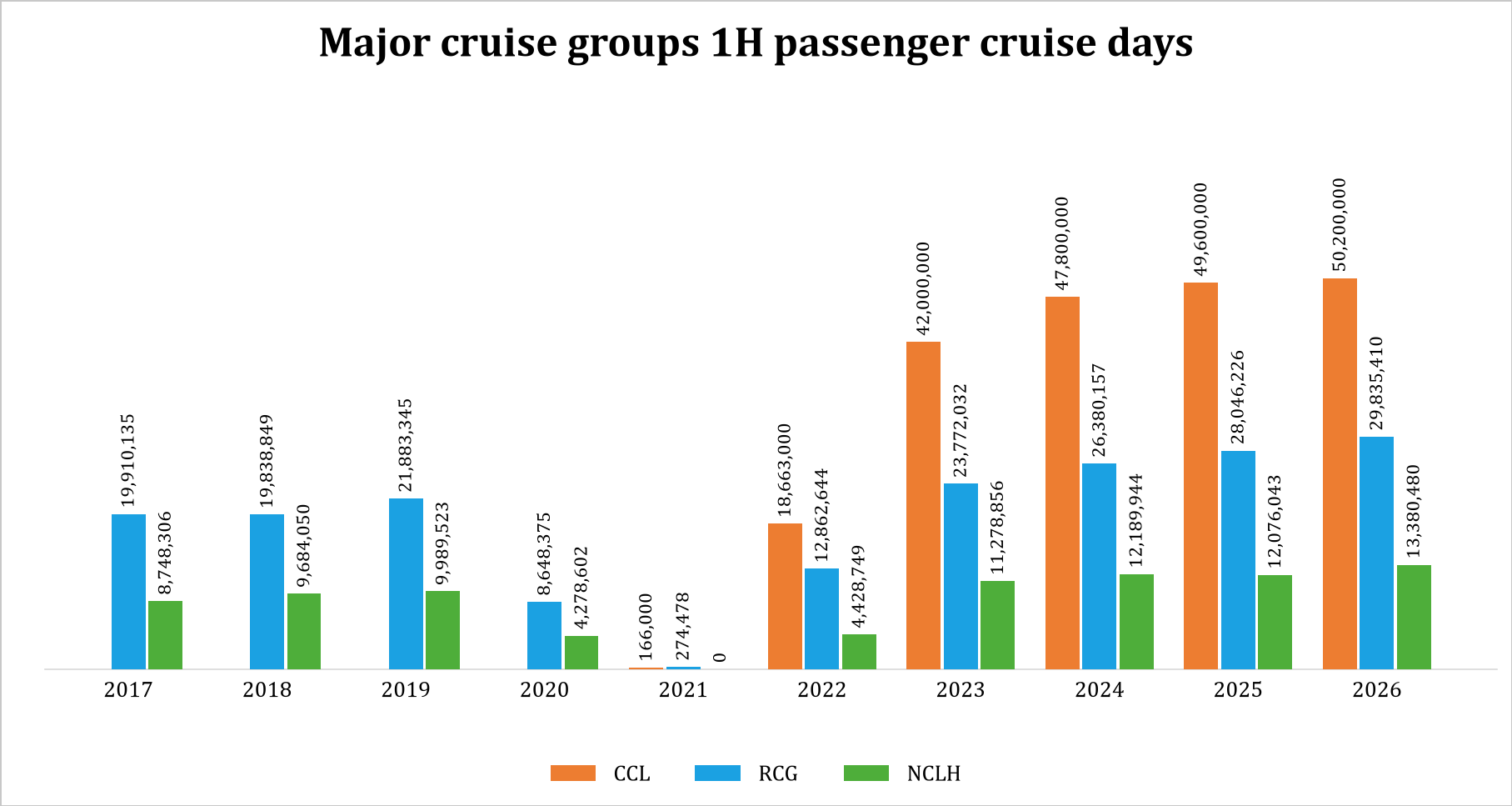
Reflecting the weakening demand, CCL reported no increase in total passenger numbers for the first half of 2026, compared to a 10.5% increase for the same period in 2025. Its all-important passenger-cruise-day number improved by only a marginal 1.2%, compared to the already modest 3.8% the previous year. So the downward trend has continued.
RCG reported an “above expectation” Q2 performance. Its six-month revenue was 8.8% higher than in the comparable period in 2025. It has been able to maintain momentum, as this percentage increase was similar to that of the year before.
RCG’s passenger numbers for the period increased by about 9.1%, slightly slower than the year before. Its passenger cruise days rose by just above 6.3%, similar to the figure in 2025. Compared with its recent robust performances, these latest figures point to a noticeable slowing trend for RCG.
After a recent spate of poorer performance, NCLH could breathe a sigh of relief as it reported a stronger revenue performance: a rise of 7% in the first six months of 2026, compared to 1.8% for the same period in 2025.
This was achieved through an incredible 26% increase in passenger numbers, after a 3% fall for the same period in 2025. Its passenger cruise days rose by nearly 11%, compared to a fall of almost 1% in 2025. By these metrics, NCLH’s fortune has unquestionably improved.

Source: CCL, RCG, NCLH
Source: CCL, RCG, NCLH
Earnings impacted
While profitability has continued to improve, the pace of improvement has slowed. This has been attributed to geopolitical instability and higher fuel costs.
For CCL, although its Q2 performance beat expectations, the pace of its overall financial performance improvement continued to slacken. Higher fuel costs and geopolitical unrest have impaired demand and profitability.
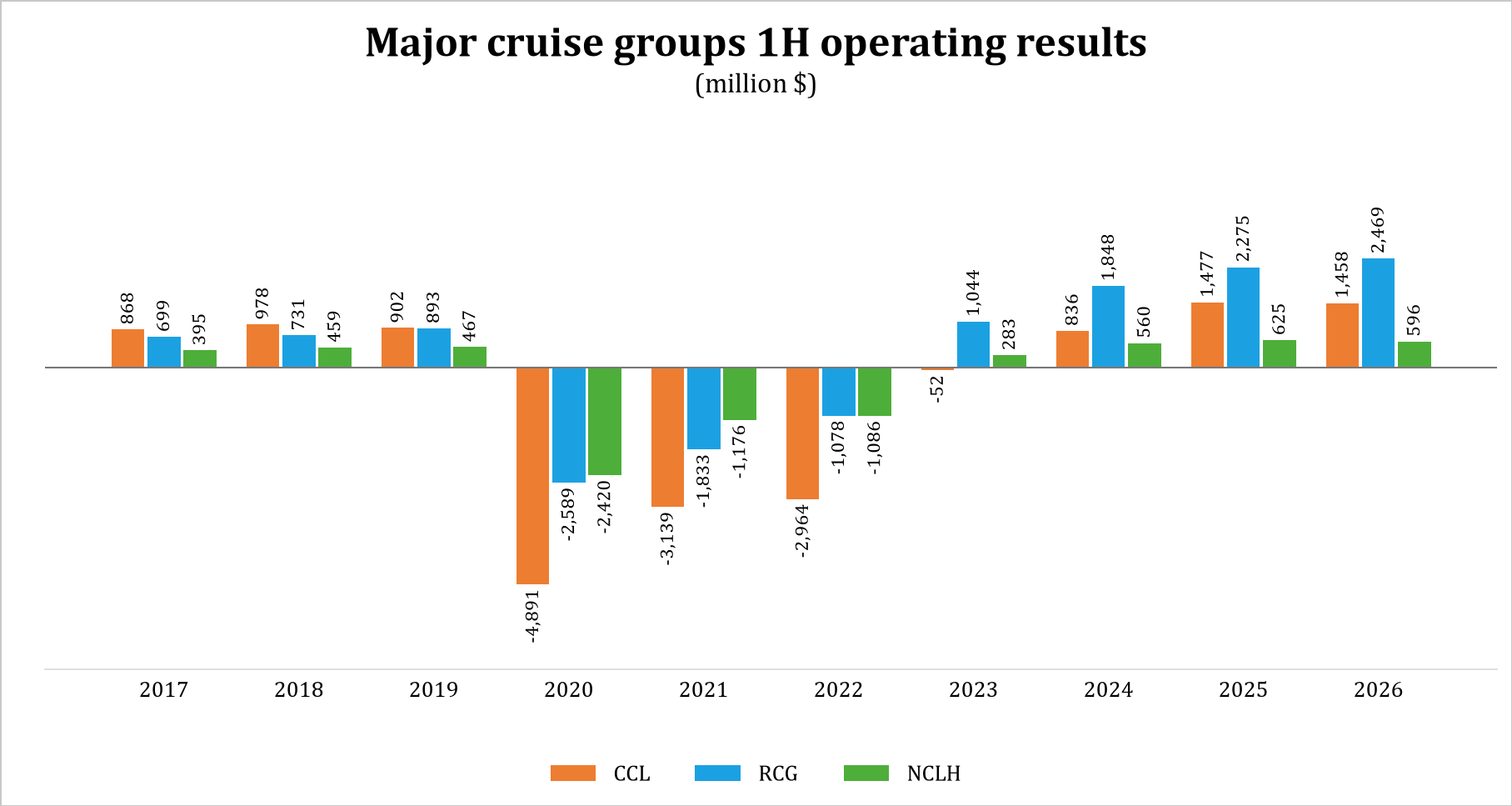
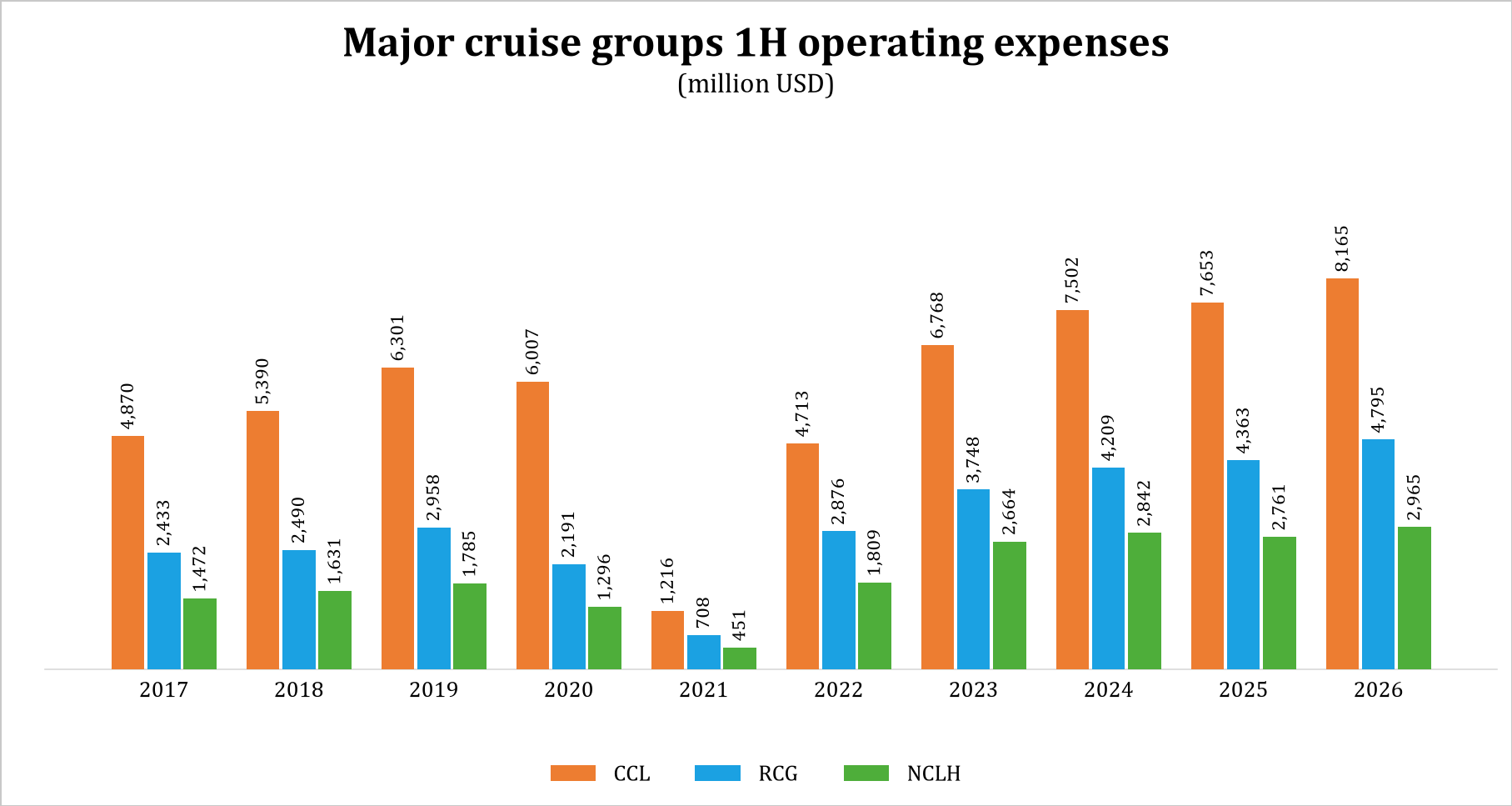
CCL’s operating expenses for the six-month period of the current financial year rose by 6.7%, compared to 2% a year earlier. This actually caused its operating income to fall by more than 1% for the same period, compared to an increase of 76.6% the previous year.
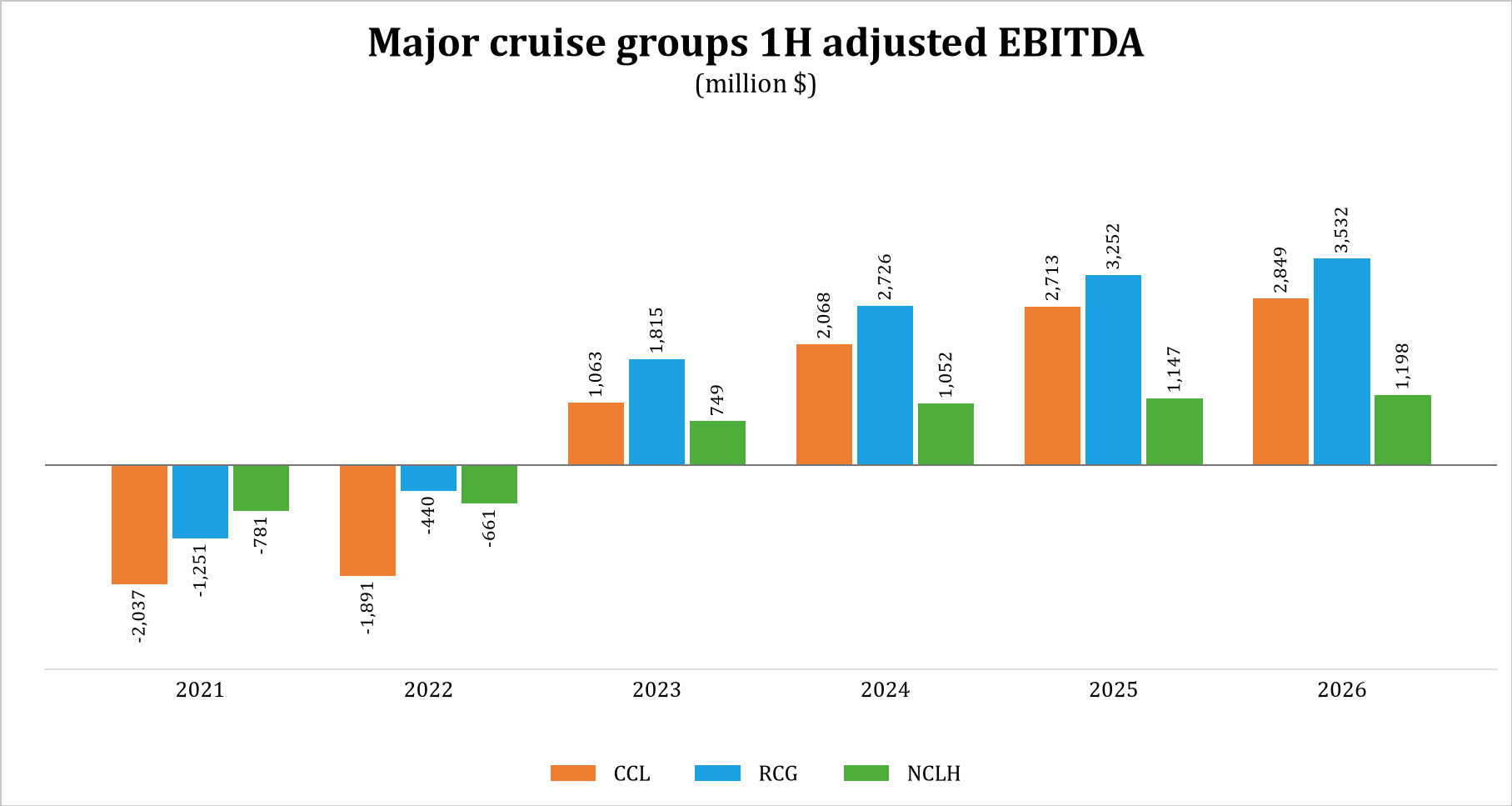
Weaker earnings were also reflected in the group’s adjusted EBITDA, which improved by only 5%, compared to 31.2% a year earlier.
But sentiment remained solidly upbeat. “We achieved another quarter of record results, marking our twelfth consecutive quarter of record net yields and delivering over 20% more to the bottom line, overcoming extreme geopolitical headwinds and nearly 30% higher fuel costs,” said Josh Weinstein, CCL’s chief executive officer.
Acknowledging the impact of higher fuel costs and geopolitical concerns, CCL trimmed its full-year guidance. (CCL was delisted from the London Stock Exchange on 7 May 2026 and became a single-listed entity under the name of Carnival Corporation.)
Depending on one’s perspective, though, CCL’s fundamentals remain robust. Weinstein continued: “Our booked position for the second half of 2026 is higher than last year, at historically high prices (in constant currency), despite navigating more than a full quarter of extreme geopolitical volatility that primarily impacted booking trends for our European deployments, particularly in the Mediterranean region, which were closest in proximity to the conflict in the Middle East.
“Looking further out, demand for 2027 and beyond remains strong. Since March, booking volumes and prices for these future sailings have been running ahead of prior year levels, including a substantial increase in bookings for our European deployments next year. These trends reinforce our confidence in the longer-term demand environment.”
Nor should investors panic. “Our strong cash flow growth enabled us to launch our current share buyback programme, repurchasing over $450 million of stock to date, reinforcing our commitment to accelerate shareholder returns,” stated David Bernstein, the group’s CFO. “At the same time, we continued to responsibly invest in return-generating programmes across our fleet and exclusive destinations, while further strengthening our financial position.”
The same impact was felt by RCG. The group reported an 8.5% increase in operating income for the first six months of 2026. This was substantially lower than the 23.1% in the same period a year earlier, because its operating expenses rose by nearly 10% compared to 3.7% in 2025. The company also saw its EBITDA improve by 8.6%, a drop from 19.3% for the same period in 2025. Its net income improved by about 7%, a sharp fall from 60% in 2025.
Though the group remains cautious, none of these slowdowns seem to have affected its confidence in its future business performance. “We expect another year of approximately double-digit growth in revenue and earnings, driven by consumers’ preference for our leading brands and supported by our strong booked position, leading margin profile, and fortified balance sheet,” said Jason Liberty, chairman and CEO of RCG.
For NCLH, its recent change of leadership and strategic realignment following a period of poorer performance seem to have paid off. Its financial performance results appear to have mitigated the geopolitical impact.
The company was able to report net income of $327 million for the first six months of 2026 – a complete turnaround from the $10 million net loss registered in the same period of 2025. The figure was also 81% higher than the $181 million net income of the first half of 2024.
However, its operating income for the period fell by nearly 5%, to just above $596 million, resulting in a weaker EBITDA of 4.5% improvement, compared to 9% in 2025. This was mainly because the company’s operating expenses rose by 7.4%, in contrast to a 2.9% fall in the first six months of 2025.
Commenting on its latest business performance, NCLH management appeared to be more cautious than the top executives of its two bigger peers. “Norwegian Cruise Line Holdings delivered a solid second quarter with profitability ahead of guidance. At the same time, we continued to advance our strategic priorities to strengthen the business for the long term,” said John W. Chidsey, the group’s chairperson and CEO.
Looking ahead, there will be no escape from geopolitical impacts for NCLH, which stated: “The company remains below its optimal booked position for the next 12 months, as it continues to experience pressure from softer demand at its Norwegian Cruise Line brand related to company-specific execution challenges, as well as the ongoing conflict in the Middle East.”
Source: CCL, RCG, NCLH

Source: CCL, RCG, NCLH
Source: CCL, RCG, NCLH
Source: CCL, RCG, NCLH
Dual impacts
The ongoing problems in the Arabian Gulf have a twofold impact on the cruise industry: higher fuel costs and higher borrowing costs.
Fuel expenses continue to be by far the biggest single item on a cruise line’s operating cost sheet. The figures have swelled considerably so far this year, and it is likely that this will remain the case through 2026 and beyond, thus further squeezing the margins.
Higher oil and gas prices have also forced some countries to sell off US treasury bonds in huge quantities to finance their energy purchases. This is being done consistently in recent months, driving up dollar borrowing costs – the currency used by more than 50% of cruise customers.
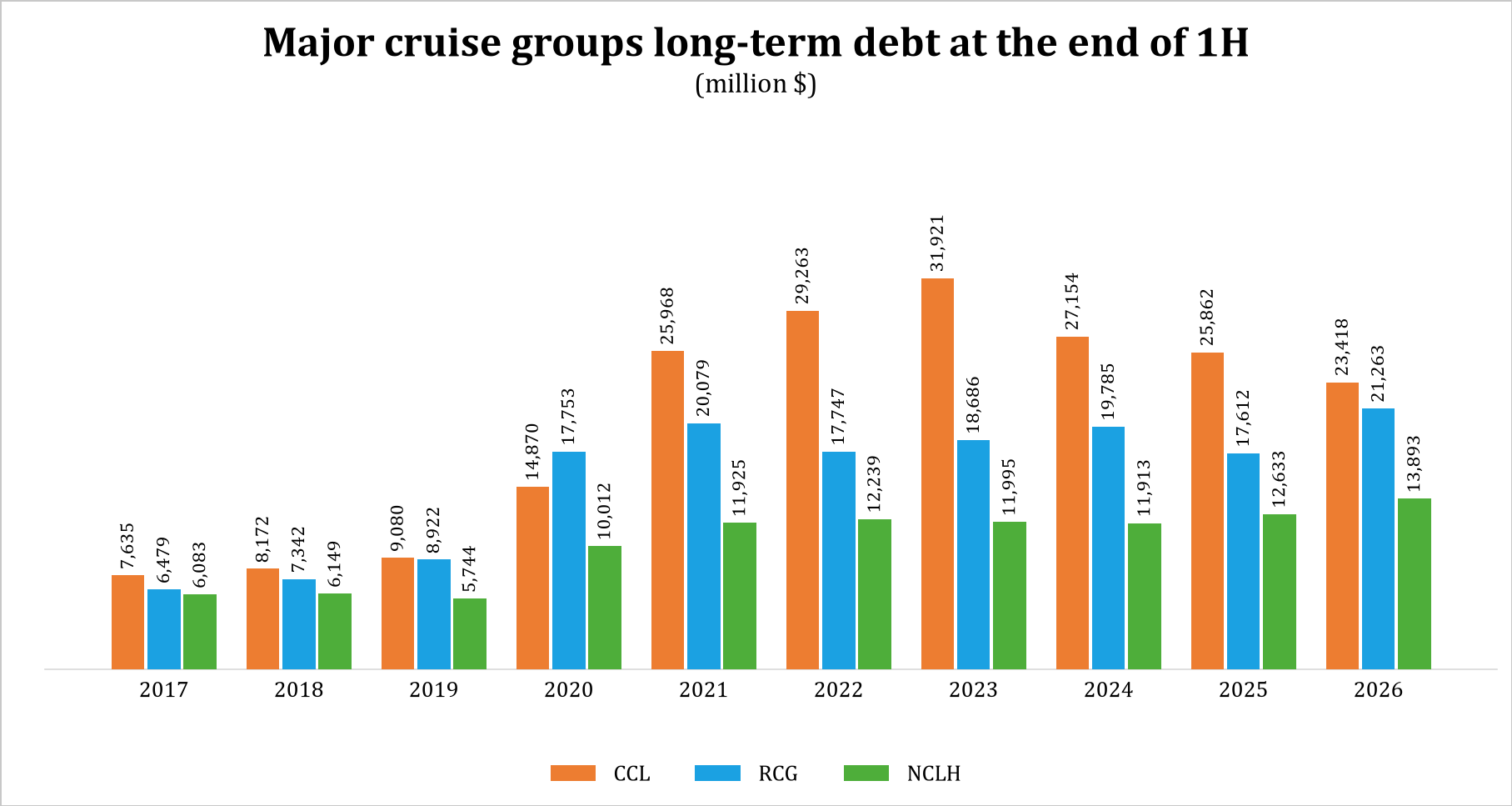
This, too, could impact negatively on a cruise operator’s ability to service its debt. Already this year we’ve witnessed rising long-term debts for both RCG and NCLH – up 20% for RCG – at a time when debt levels should be falling.
We believe the softening of demand will persist for the rest of 2026 and possibly beyond, putting pressure on revenue growth. The situation has intensified in recent days because of Houthi hostility in the Bab al-Mandab Strait, the Red Sea choke point. This could mean further hikes in energy prices.
In the longer term, we may be seeing the erosion of the dollar’s privilege as a result of geopolitical realignment. The dollar’s status as the global reserve currency is being rapidly undermined by the upheaval in US domestic and international policy. This will have a lasting impact on the cruise industry, which depends disproportionately on the US source market and US-based cruise lines.
Source: CCL, RCG, NCLH


